Monday, January 6, 2020

New Year’s Resolutions for Creative Photographers


It’s that time of year when your friends and family begin to bug you for your New Year’s resolutions. So, in this article, I’ll share with you some possible New Year’s resolutions for creative photographers.
Apparently, humans started making New Year’s resolutions four thousand years ago. So you’re in good company if you want to make some this year!
new-years-resolutions-for-creative-photographers
You might be considering pledging to go to the gym more or stop biting your nails (but we know you’ll never last past January). So instead, why not think about how you might use the new year to make some changes to your photography? You never know, they might even stick for longer than a month!

Reflect on the past year

Take some time to review the photos that you’ve taken during the past year. Pick out the ones that you like the most and try to think about why they make you feel that way. Are they perhaps full of happy memories? Or did they mark a moment when you understood a new technique?
Consider turning your favorite photos from the year into a photo book to permanently make a record of what you achieved. Think of it as being like a journal of your hobby that you can look back on in the future to see how much your approach to taking photographs has changed.
New Year's Resolutions for Creative Photographers
It could be that many of the things you enjoyed most about photography over the past year were the experiences. Maybe you enjoyed spending time with certain other friends who are into photography or going to different places. Make a note of those experiences you enjoyed the most, and we’ll come back to it later!

Don’t be afraid to take risks

Taking risks with your photography can be a useful tool to help you improve. Cameras are tools that are meant to be used and they can always be replaced.
But taking risks doesn’t have to be about putting yourself and your equipment at risk. Sometimes it can be about pushing your boundaries and taking creative risks.
The worst that can happen when you take a creative risk is that you get a photograph that isn’t as good as you hoped it would be. And if that happens, you don’t have to show anybody! But when a creative risk takes off… that’s when risk-taking really becomes worth it.

Take your camera everywhere

The famous hockey player Wayne Gretzky said that you’ll miss one hundred percent of the shots you don’t take. He’s not wrong – if you don’t have a camera with you, then you won’t be taking any photos!
New Year's Resolutions for Creative Photographers
Two years ago, I realized that I wasn’t taking my camera out and about with me because it was too big and heavy. Shortly after, I ‘side-graded’ to a more compact camera that was easier to take with me everywhere that I went.
My photography improved almost immediately. I was simply taking more photographs and getting more practice. Over time I also found that I was finding more excuses to take photographs because I was enjoying photography more than I ever did previously!

Say ‘yes’ more often

It’s too easy to say no to opportunities that crop up. You might think about the other things that you ‘should’ be doing. You might think about the money that you could be using for something else. But how much would it really hurt if you said ‘yes’ a few more times during the upcoming year?
Say yes to a photographic adventure with a friend. Say yes to a new kind of photography. Also, say yes to new styles and techniques that someone offers to show you. And, say yes to things that are outside of your comfort zone.
You might not enjoy everything that you photograph as a result of saying yes, but then you’ll certainly know for the future when to say no!

Plan your year in advance

Each year I buy an almanac, and I first use it as a convenient list of key dates and celebrations that I might want to explore photographically. But a good almanac book will have so much more than just a calendar.
New Year's Resolutions for Creative Photographers
Divided into monthly chapters, almanac’s have tide tables, information about the night sky, and what flowers are in bloom that month. It’s a guide to what you should see in nature, and some almanacs even have seasonal recipes.
Imagine if you let the almanac be your guide for photography over the coming year? You’d shoot everything from seascapes, wildlife, and cultural celebrations to food photography.

Start a passion project

The first thing to know about passion projects is that they don’t have to change the world. They don’t have to be big, dramatic, and meaningful; they just have to satisfy you and your desire to take photographs.
I like to use passion projects as a way to help me be more attentive to the world around me or to work on skills.
This year I have been setting aside the time to shoot a self-portrait every month to improve my portrait photography. While working in London as a photographer, I documented my changing walk to work for several months, as industrial development happened around me.
Use it as an excuse to get out and about and photograph things that you might not normally photograph. A friend of mine, this year, has been visiting every UK Cathedral and photographing them all. He sees parts of the world that he’s never seen before – despite them being virtually in his backyard!

Set some goals

Setting goals for your photography can be a good way to figure out how you’re going to spend the next year. Goals can help inform the trips you take, the accessories you buy, and ultimately the pictures you make.
new-years-resolutions-for-creative-photographers
Take a few minutes to consider what you really want out of your photography hobby. Is it perhaps more time for yourself with a camera? Or do you want to win a local photography club competition? Think about what you wrote down when you considered what you’d enjoyed most over the past year photographically.
Once you’ve come up with a few goals, start thinking about how you can achieve them. Do you need to take a specific trip to photograph some wildlife? Or do you need to book a workshop with a photographer who’s style you love?
Whatever you write down, make sure you tuck these ideas away in a safe place so that you can keep looking at them throughout the year. That way, you’ll find it easier to stay on track and achieve your goals.

Take more photos!

Everything I’ve talked about in New Year’s Resolutions for Creative Photographers is just a way to try and help you shoot more photographs that you love over the coming year.
new-years-resolutions-for-creative-photographers
By working out what you enjoy photographically, and where you want your journey to go over the coming year, you can start to make a plan to help you achieve your photographic goals.
Do you have any New Year’s resolutions for creative photographers you’d like to share? What are your goals for the upcoming year? What are you doing to try and do differently? Don’t forget to tell us in the comments!

Share this article.
Viral video.  Here's another inspiration for you Videographers. Enjoy!

Sunday, January 5, 2020

Minimalist Photography: A Powerful Medium That’s Not as Easy as You Think


Do you want to make more powerful minimalist photography? Then this is the article for you. Here, I’ll clarify what minimalism is, and more importantly, what is not. I’ll also give you some tips and tricks to improve your own images and share some quotes and links from the masters on the subject to get you inspired.

What is minimalist photography?

I find that some people use the term minimalism to describe a kind of photography, for example, when they are replying to what type of photography they do. That’s why it’s important to clarify that minimalism is a style of photography that you can apply to any genre of photography from landscape through to food photography.
Powerful minimalist photography
1/1000, f8, ISO 200
Actually, minimalism is a style that not only exists in photography but in everything from paintings through to design. It is even a way of life that has recently become popular. The one thing that minimalism has in common, no matter where you use it, is the idea that less is more. Because of this, the details are very important.

Know-how

While minimalism is simplistic in it’s visual aesthetic, it is not always easy to achieve. In fact, it can be more difficult because there’s really no place to hide. If it’s not a good photo, it will be fairly evident. One of the first rules of powerful minimalist photography is to isolate the subject and let the background be just that, a background. You can achieve this by using neutral backdrops or a shallow depth of field.
Image: 1/320, f11, ISO 400
1/320, f11, ISO 400
An isolated subject on a neutral background is not yet enough to qualify as minimalist because this description could include product photography from an e-commerce site and, of course, we are not talking about that.
So to achieve minimalism, you also have to give a message or emotion. Michael Kena, the great minimalist photographer says: “For me, approaching subject matter to photograph is a bit like meeting a person and beginning a conversation“.

Composition

You can use composition to give more impact to your image. There aren’t many elements in a minimalist image, so you have to be sure they are well-positioned and distributed correctly. You want to use composition to create a harmonic image and emphasize the subject. Always keep in mind the message and not just the aesthetics.
Composition for minimalist photography
1/60, f4, ISO 400
Using composition rules can really help you to master minimalist photography. Once you’re comfortable with them, keep experimenting because breaking the rules can sometimes be equally helpful.

Colors, shapes, and textures

You can try using only one color to emphasize the message or create an atmosphere and a feeling. There’s a long history in the arts about the cultural meaning and the psychological impact different colors have on the viewer. Use this to your advantage when doing minimalist images.
Urban powerful minimalist photography
1/640, f4.5, ISO 250
You can also go the other way and use bold, contrasting colors to create more compelling photographs.
Lea De Meulenaere said in an interview that she lives in a place that is not very colorful, so she does more profound research to use other characteristics of the minimalist style. Keeping this in mind, you can also use shapes and textures.

Constructing images

Minimalism can be found during long walks in the city for urban photography or nature for landscapes, but you can also construct it in still-life, food photography, advertising and other genres.
Image: 1/60, f11, ISO 400
1/60, f11, ISO 400
Some big brands like Disney or LG are using minimalism for their printed advertising. You can follow the creators of such campaigns on Instagram for inspiration. I particularly like Anna Devis and Daniel Rueda under the account name anniset.

Why you should give it a try

  • Trying new things will keep your photography improving. Going minimal doesn’t require you to buy any new equipment. You have nothing to lose and much to gain.
  • It will exercise your mind and creative process to give a clear and concise message with your images.
  • There’s such a big variety of minimalism that you can find your own. You can go about it as a meditative state or as a fun creative project. The choice is yours.

It’s not by chance that advertising is using minimalism. An image that clearly communicates what you want is something that stands out in between all the images we see every day. To make powerful minimalist photography is a skill that can take your work to the next level.
Powerful Minimalist photography monochrome nature
1/500, f5.6, ISO 100
Try it, practice it and most of all, enjoy it. Share with us your results in the comments section to get other readers inspired!

Want to read more about minimalist photography?

See these articles:

 Share this article.

Cell Phone Videography

Viral Video.  For you Videographers here's an idea for your next video project. Meet the Landlord.  Enjoy


 The Smartphone Filmmaking Handbook: Revealing the secrets of smartphone movie making
   Get your copy here: https://amzn.to/3b76mGJ


(Pssst...as good a deal as this is at only $7.99, how would you like to have access to the Smartphone Filmmaking Handbook absolutely FREE?  Just scroll down to the bottom of this page and click on the Amazon Kindle Unlimited Reading offer)
Amazing Photography Tricks

Saturday, January 4, 2020

9 Steps to Get Over Your Fear of Off-Camera Flash

fastflash_bookIf you want to learn more about using flash for creating portraits, pick up Gina’s brand new dPS ebook: https://resources.digital-photography-school.com/ref/937/   For the first three years as a professional photographer I suffered a severe case of Photophobia and Photoaugliaphobia. I tried to cover it up by saying things like, “I’m a natural light photographer” or “I really don’t like the aesthetics of flash photography”. In reality I was scared to death of using flash. I just couldn’t wrap my head around the concepts and science behind it.

Fear: False Evidence Appearing Real

  • Photophobia – Fear of light
  • Photoaugliaphobia – Fear of glaring lights
Each shoot I went on that involved flash was accompanied by a sleepless night, with dreams about turning up to the shoot naked (anxiety dream) and just the thought of having to use flash, also had a mild to moderate laxative effect on me.
Fearflash main
I managed to work out a system where if I shot at f/8, with the flash dialled in to a particular spot, I would end up with a shot that looked half decent. I had a few successful shoots (and by that I mean there was a detectable image on the film, often blown out by two stops) and was feeling pretty confident about my high-tech – stand here, shoot at f/8, and don’t change anything on the dial – approach to flash photography.
I started getting cocky and developed a “geez you’re good you should do this for a living” strut. In my mind, I’d mastered flash. Sure it wasn’t amazing, but I’d convinced myself that I was pretty good at it.
Then everything changed. I botched a few big jobs in a row; a wedding, where only one frame turned out, a corporate shoot where the flash overexposed the logo, and a historic family portrait where 200 members of the same family flew in from around the world to be in one place together. I set the camera to the wrong shutter speed. The only record of the event is now a faded memory.
Gear 11
I blamed Flash. It was the common denominator – it’s unreliable, difficult to use, and completely stupid. Why bother, I’m a natural light photographer and I don’t need this in my life.
I then started to go through all the stages of grief:
  • Denial – this isn’t my fault right? Flash did it. It’s stupid, right?
  • Anger – what do you mean this is my fault?? Are you kidding me?
  • Bargaining – dear God/Universe/Oprah please make this go away. I will never eat Nutella again.
  • Depression – I suck at photography, what was I thinking? Who do I think I am?
  • Acceptance – I suck at photography, what was I thinking? Who do I think I am?
Probably the toughest, and most grown-up thing I did as a professional photographer, was to face up to the fact that I sucked at flash photography. I needed to develop a learning style, a protocol that would help me understand flash, learn how to use it well, and stop being afraid of it.
PG 51 manual mode
Learning a new skill can be overwhelming at first. I can still remember learning to drive stick shift, and bunny hopping my father’s car around the block, stalling at every red light and being frustrated at the number of things I needed to remember. At the time, I thought there was no way I could possibly remember how to do everything. But, little by little, day by day, I started to overcome the shock of the new, and driving became second nature.
I think the reason that many photographers become frustrated with flash, is because they are working with lighting styles, and modifiers that are too complicated and involve too many variables. Most of us are impatient. We want to get to the “good stuff” right away. But the danger is that you never really understand the subtle differences between each lighting style and modifier.
When it comes to teaching flash photography, I like to implement what I call, The Bruce Lee Protocol. Bruce Lee was a master in martial arts, whose training requires participants to master each level, or belt, before they move on to the next. If a white belt in Karate attempted to break a plank of wood with a roundhouse kick, they would probably end up breaking their foot.
Fearflash 2b
We all want to skip straight to the black belt, but doing this before we’re ready usually ends with tears.
Taken for: Japan Karate Association Australia (JKA)
It took me many years to realize that owning every single light modifier and photography gadget, was not going to make me a better photographer. The one thing that would improve my photography was deciding on one lighting style and modifier, and working with it until I felt I’d mastered it.
I use one light with the same modifier for 80% of my fill-flash photography. I can vary the look of my shots by the way I expose my images, and where I position the light. If you’re just starting out, I recommend that you buy only one modifier and one light, then work with that setup until you’re confident, and happy with your style. Here is my stepped approach to learning how to light with flash based on The Bruce Lee Protocol.

The Bruce Lee Protocol to Learning Flash

Just like training for a black belt, I believe it’s a great idea to stay on one level, until you feel 100% ready to move on to the next. A white belt in Karate would never attempt to break a plank of wood in half with a roundhouse kick , a newbie to lighting shouldn’t attempt to work with a beauty dish before they have mastered working with an umbrella.

Step One: White Belt – Laying the foundation

I think it’s a great idea to ease into lighting, by starting with daylight. Work with hard light, soft light, flat light, and contrasty light, until you are confident you can notice the subtle differences.

Step Two: Yellow Belt – Easing into a new way of thinking

Start by adding fill-flash to your images, using flash on-camera, set to auto. This will give you the confidence to continue working with flash. The next stage is to introduce flash on-camera modifiers, to soften and shape the light.

Step Three: Orange Belt – Expanding your knowledge

FlashPoint Li-on zoom flash and commander set
Umbrella light is a great choice for a fill-light. It closely resembles daylight, making it perfect for lighting large areas. Because the light is very soft and spreads everywhere, this is the easiest light shaper to work with, making it an ideal light modifier to start learning.

Step Four: Green Belt – Developing your skills

Once you have gotten the hang of working with umbrellas, try adding reflectors to your shot, and focus on balancing the daylight and flash.

Step Five: Blue Belt – Confidence

It’s time to ditch the Umbrella and move up to softboxes, umbrellas boxes and octaboxes.
The umbrella box is the most convenient light modifier, because it combines the simplicity of an umbrella, with the control of a softbox. The box design eliminates the complications of using this modifier outdoors. Umbrella boxes are also cheaper than softboxes, so they’re a great choice for your first serious light modifier.
Head 5 200
Softboxes create a soft light that is more contained than that from an umbrella. This makes it a better choice of light modifier if you want to light only certain areas of your image. They are completely enclosed, and are a much better light modifier to use outside, as they are less likely to blow around in windy conditions.

Step Six: Purple Belt – Getting serious now

Once you have mastered soft light, it’s time to start experimenting with hard light. Hard light is tricky to work with, because there is very little room for error. Hard light modifiers include beauty dishes and grid spots.
If you’ve done all the work, adding a beauty dish or grid spot to your lighting setup, will be much easier to manage at this stage.
Fearflash 1

Step Seven: Brown Belt – Bringing everything together

Now you are ready to work with hard and soft light at the same time. The hard light, like a beauty dish or grid spot, can be used as the main light, and the soft light becomes the fill.

Step Eight: Red Belt – Developing your own style

Once you’ve mastered each of the lighting styles individually, and know how to work with them together, you can focus your attention on developing a lighting style that is unique to you.

Step Nine: Black Belt – Enlightenment

A black belt in lighting comes with the realization that we never really stop learning. Most of the best photographers in the world will admit that they are yet to master their craft, and the more they know, the more they realize they have yet to learn.
One of my greatest highlights of the past few years, has been watching the students I have taught overcome their fear of flash, and seeing their styles evolve and develop.
Here are some of my favourite examples of their work, and the steps they took to create these images.

Lisa McTiernan

Lisa McTiernan
Off-camera flash has scared me for a while now. Finally! Simple, easy to understand info, that even after one go has opened up a whole new world for my photography. Gina Milicia you’re my hero. Legit.
I wanted a moody vibe for this shoot in an empty concrete carpark. I wanted the shot to look like it was lit by the fluorescent lights on the walls and ceiling, and not by my speedlight. After setting the exposure for the ambient light, I bounced the flash (with the diffusion dome) off the ceiling at an angle to soften, and bounce it back onto my subject’s face and upper-body to highlight his red shirt. I set the flash to 1/16 power, and adjusted the level until I got the look that worked. Exposure: 1/100th, f/5.6, ISO 500, 27mm lens.

Kristi Louise Herd

This is from a photo shoot I did with an aspiring model, it was my first night shoot and my first using flash. Before I did the shoot I read and re-read your ebook, Portraits, Lighting the Shot. Tricks I learned from you became invaluable. I used the trick with the phone to focus, as the light was pretty dim. It worked fantastic, and the softbox, which I had never used before, was held just above and sightly to the left of the model (I had seen this again in a diagram from your ebook). Camera settings: Nikon D750 f/4.2, 1/30th, ISO 800, focal length 112mm. I would never have achieved this shot without learning from you Gina Milicia.

Erica Rampant

Erica Rampant
Hi Gina, I asked a few weeks ago about placement for lighting for a milk bath shoot. Here is the result! It was taken with a Nikon D610, 50mm Sigma Art lens, ISO 100, f/2.2, 1/160th of a second.
This is my friend Antonette, she just gave birth to a healthy baby boy and I was there to photograph it. She had a home birth and her baby was born in water! I’m still a new photographer and have only been shooting for five months, but have been listening to you, and learned so much!

Natalie Ord

Natalie Ord
This is a shoot a recently did for a client. The day was windy, overcast, and I had limited time. I needed to portray the client as friendly, accessible, and show that she is rural-based, so it was important for me to get the background exposed right. I couldn’t have done that without using off-camera flash.
Settings were 1/320th, ISO 250, f/7.1, using PocketWizards, a Canon Speedlite 600EX without a softbox, as it was windy and I didn’t have anyone to hold the stand, shot on my 70-200mm f/2.8L with a Canon 5D MkII.

Gary Lun


Gary-Lun-3
Canon 5D MkII with Canon 16-35mm f2.8 at 18mm, f/4.5, 1/125th, ISO 1600. Flash was Yongnuo YN560III at 1/8 power, positioned at camera right. Softbox was using SMDV SpeedBox-60.
Quick story: I was doing an engagement shoot at a typical location in town for many photographers. It was packed with photographers that day! Anyway, in order to get a unique photo I knew I must use flash. So I waited until all other photographers were gone, because the sun is going down (since most of them were using natural light), took my flash out, asked the couple to stand near something with texture, and took the shot.

Phil Enn

Phil Enn
Canon 7D, 17-85mm at 17mm, f1/6, ISO 200, six speed lights held in a bunch, off to camera right.

Andrew McNamara

Andrew McNamara
Canon 5D MkII, 24-70mm at 24mm, f/9.0, ISO 100, 1/50th with a camera-mounted Canon 480exII Speedlite. As stated in the original story, shot from inside a training element for the Southern Cross Search Dogs photoshoot. I had a diffuser on the flash, just for the safety of the dogs eyes, and bounced it just a little.
P.S. I’m one of those people who are afraid of flash so this was a big step!

Rahim Mastafa

Rahim Mas
Inspired by one of your ebooks, I used one studio strobe as a key light to the front of him, and a speed light as a kicker, over his shoulder on the backrest. Settings were: f/2, 1/1500th, ISO 100, Sony a77, 50mm lens.

Matt Zahn

Matt Zahn
This was part of my self portrait challenge. Since it was nighttime, and obviously no natural light to shoot with, I attempted to create the illusion that this was natural light coming through a window. I used my Canon 430exII Speedlite on my T5i. I slid a home-made snoot over the end, and used some electrical tape to create some of the shadows. This shot was taken at 1/400th, f/5.0, ISO 400. I also placed a gold reflector to camera left, behind me.

Scott Stokhaug

Scott Stockhaug
With the help of your ebook, Flashfast for Portrait Perfection, I made a minimal investment to get that speedlight off my camera, and open many new doors! This photo is my Rembrandt lighting, along with black background that was shot in my home, in broad daylight, with no backdrop. I love this technique!

Next step

So where are you on The Bruce Lee Protocol steps? Do you have a fear of flash? Have you overcome and mastered it already? Please share with us where you are, and what you’ve done to conquer your fears.
Save it to Pinterest: here’s a graphic for those of you on Pinterest who want to save this article for later.
9 Steps to Get Over Your Fear of Off-Camera Flash

fastflash_bookIf you want to learn more about using flash for creating portraits, pick up Gina’s brand new dPS ebook: 
https://resources.digital-photography-school.com/ref/937/

Share this page.

How to Overcome Fear in Photography

Fear. It’s an emotion to which we all can relate. Luckily, nervousness or fear in photography can be overcome with practice and patience. After speaking with a few fellow photographers and borrowing from my own experiences, I have listed some shared fears among photographers and ways you can learn to overcome them.
Overcome Fear

1. The fear: I’m afraid I don’t know what I’m doing.

Every photographer at some point feels a little out of their depth when encountering a new situation or problem. Whether it’s learning to use a new piece of equipment, a lighting conundrum, or simply making a careless mistake during a shoot – we all can feel a little lost from time to time. This is especially true when a person first begins to learn the art. There’s a lot of somewhat technical information to absorb and it can be frustrating to understand new things. I recall shooting my first large wedding. I was so nervous that I was sweating more than the groom. There were some hiccups but overall the shoot went smoothly and the client was pleased.

How to beat it:

Acceptance. That’s the best way to overcome your fear of being inexperienced. The most effective thing you can do as an aspiring photographer is to constantly remind yourself that we all start somewhere. At some point, even the most celebrated of photographers didn’t even know how to operate a camera. You will learn as you go and you will make mistakes. You will also have successes. The key to beating the fear is the determination to keep going.

2. The fear: I’m afraid people won’t like my work.

The fear of rejection is a biggie. We all feel it to some extent and we all struggle with the fact that some people simply will not like the work we produce. This is the beauty and the bane of any art form. Art, by its very nature, is extremely subjective. Each person will view a piece with there own eyes and make judgements based on their experiences.
Here is one of my personal favorite images and one of the least liked by the public.
Ferns

How to beat it:

When I first began my photographic journey I was easily discouraged. It seemed that for every roll of film I used there would be only one or two decent exposures. I would get so frustrated to point I would just put down my camera. Fortunately for me, I stumbled upon this quote from Ansel Adams:
“Twelve significant photographs in any one year is a good crop.”
That sentence hit me hard. I realized that if one of the most influential American photographers of all time was happy with twelve good images in an entire year, then I should be thrilled of the progress I was making! As painful as it can be, failure is an essential learning tool. Seldom do we gain new knowledge only from our success. Do your work as best you can and show it to the world. The rest is out of your control.

3. The fear: I’m afraid to photograph people.

Making photos of people can be compared to public speaking. Very few people (I haven’t met any) are able to hit the ground running when it comes to street or event photography. It’s just not easy. Anxiety is a constant, at least it was for me. I would worry about how the subject might react to being photographed or if I looked strange photographing a stranger on the street. Even the act of carrying my SLR around in public made me feel out of place.
Child and Grandmother

How to beat it:

The short answer – just do it. Go out and confront your fear. It sometimes helps to begin in a place where other people will likely be carrying cameras such as a public park, farmers market, or other large gathering. You will feel more at ease knowing that you aren’t the only one making photos. As you become more relaxed, begin taking your camera with you on a daily basis.
Practice short excursions around your street or neighborhood and get used to being around people while using your camera. The more you do something the less frightening it will likely become.
Boston Common
Before you know it, you will be able to approach public situations with confidence.
Party

4. The fear: I’m afraid my gear isn’t good enough.

Gear envy. That nagging notion that if you only had this lens or that filter or if you could afford the newest whatever – we all experience it to some degree. It’s a basic condition of humans to want what we don’t have and photographers (most, not all) are notorious for never having enough. We can sometimes let ourselves be afraid that our gear just isn’t up to the task and become convinced that all we need is more and better equipment.
Gear

How to beat it:

The best way to overcome the fear of gear inadequacy is to understand that you will never have the best gear because the best gear hasn’t been made yet. Everything is evolving and you only have to do a quick internet search to realize most camera gear updates every couple of years. Stop focusing on what you don’t have. Instead, learn to make the most of what you do have. Study the capabilities of your gear and know what it can do. More importantly, understand what it can’t do. Constantly I see eager photographers become disappointed and discouraged because their expectations grossly overwhelm the capability of their gear. If you have realistic expectations then you won’t be so prone to doing the worst thing a photographer can do – which is quit.
Do you suffer from any of these fears? Do you have others not listed here? Share with us in the comments – we’re all friends here and support each other in getting over our fears.

Share this article.

How to Conquer Your Fear of People as a Photographer

You know the feeling; shyness around strangers, dreading new situations, sleepless nights worrying, completely self-conscious in a crowd, thinking that everyone is judging you. In short, a fear of people.
Your fear and inhibition are like having “stage fright” in everyday life. All of this leads to you suppressing your personality, your creativity, and any chance to share your gift of photography with your culture and the world. All of this fear is dangerous because it blocks your creativity, making you become miserable and anxious.
But there is hope for you because many folks have overcome their fear of people and gone on to thrive as photographers. Below are five exercises that will help you to conquer your fear of people too.
Climbing child on playground equipment - How Conquer Your Fear of People as a Photographer
My son used to be afraid of heights at the playground. But I knew he could overcome it. So every time we were at the playground I would encourage him to try something with heights. He’d go just a little bit higher each time until he had completely overcome his fear.

How to Overcome Self-Consciousness and Fear

“If you want to conquer fear, don’t sit home and think about it. Go out and get busy.” – Dale Carnegie
The way to overcome self-consciousness, fear, and shyness is to practice the healthy opposite.
What is the healthy opposite of fear and inhibition? Having a healthy confidence, the ability to enjoy other people, and the courage to try your best and accept constructive criticism. Here’s how you can work toward that.
Window light portrait. - How Conquer Your Fear of People as a Photographer
It used to be extremely intimidating to ask friends if I could take a portrait of them. At a favorite coffee 
shop of ours, I asked my friend if I could snap a few photos while we were talking. I was really 
intimidated by this, but it becomes much easier once you do it a few times, trust me.

1. Begin with a Healthy Goal

Without healthy goals to aspire to, your life will be stagnant. You need a goal or you have nothing to move toward. Here’s a good goal for you if you’re a fearful photographer. Aim to become a creative photographer who is comfortable and confident with people.
Setting a goal doesn’t help you much unless you’ve got some steps to achieve it. Let’s see how to practice the healthy opposite of fear so that you can become “a creative photographer who is comfortable and confident with people.”
Begin with the smallest steps possible, and gradually improve from there.
Walking the dog. How Conquer Your Fear of People as a Photographer
When I was a kid I was afraid of dogs. I didn’t want my kids to be afraid of dogs so I made sure that 
they were around dogs from the time they were infants. Whenever they showed fear I helped them to 
be brave and get comfortable with the dog.

2. Use Your Voice

If you’re afraid of people, you probably don’t speak much. You’re likely afraid of having your ideas rejected, giving damaging advice, or being locked in a heated debate. But as long as you’re a kind and thoughtful person, these things aren’t likely to happen often.
The worst part about speaking up is the nervousness you feel just before saying something. Ignore that “stage fright.” Overcome it by saying something small. Don’t go big, just practice by making small talk.
Portrait in a coffee shop - How Conquer Your Fear of People as a Photographer
I’ve challenged myself to try street photography or photographing people while out and about. I was 
sitting in a coffee shop reading about photography when I saw this gentleman quietly having coffee on 
his own. I couldn’t resist taking a picture, waiting for the moment that he brought the coffee cup up to 
drink.

Baby Steps

Perhaps you’re interested in street photography, but you’re so afraid of people that you could never ask for a portrait of them. You could practice getting comfortable by making small talk with strangers. Don’t even bring your camera along, that’s too much pressure. Just practice small talk.
Once you get over that initial discomfort of striking up a little conversation, asking strangers to take their picture won’t be as scary.
Mayfly - How Conquer Your Fear of People as a Photographer
Add bugs to the list of things I’ve been afraid of! One summer I took a macro lens around and 
photographed bugs. The time I spend photographing them and editing the photos seemed to make 
me much more comfortable with bugs! Slowly exposing yourself to the things that cause fear will 
help you to overcome them.
lady bug macro shot - How Conquer Your Fear of People as a Photographer

On the Job Training

Another way to become comfortable working with people is to get a job working at a department store portrait studio. If you work during the Christmas rush you’ll have the opportunity to photograph hundreds of families.
Because it’s your job, you’ll be forced to talk with them. This repetition will help you get over your fear of talking with people. Remember, you’re not there for the photography itself. You’re there to practice talking with people so that you can get over your fear and move toward your goal of being a creative photographer who is comfortable and confident with people.
First hair cut. How Conquer Your Fear of People as a Photographer
My little girl tends to be shy of new people and new situations. It takes a little while but she will 
become comfortable with friendly people. She was very shy for her first haircut but now loves a day 
out to get her hair done.

3. Offer Compliments

If you’re not sure how to start a conversation, start by noticing something that you can sincerely compliment a person about. Self-consciousness and fear paralyze you by keeping you focused on yourself in negative ways. If you’re always self-conscious, then you need to just take the spotlight off yourself by focusing on other people instead.
When you focus on offering people compliments two things will likely happen. First your attention is turned away from yourself and on to them. Second, your mind is turned away from negative thoughts (about yourself) and toward positive thoughts (about them) instead.
When I was a senior portrait photographer I would always find some little thing to compliment students about. If it was obvious that they spent a lot of time on their hair, that’s the compliment I gave. Maybe they had a great smile, or were funny, or we had something in common.
Focusing on the other person and having something nice to say will build bridges and help you to overcome your fear and discomfort around people.
Riding the escalator. How Conquer Your Fear of People as a Photographer
Escalators can be intimidating the first time you step on one. Kids are afraid they’ll get swallowed up 
in the moving steps. Once my kids figured out how to ride one, they treated the escalator like a ride at 
an amusement park! Overcoming your fear can lead to exciting things in life.

4. Visualize Criticism

You may quickly get over the fear of talking to people or the anxiety you feel over negative thoughts about yourself. But how about receiving criticism of your photographs? This is one of the worst things imaginable for some photographers.
If you panic or become consumed with anxiety and want to “just give up” over the slightest criticism of your photos, then you need to learn to take criticism better. It’s not comfortable at first, but it can be done.

Here are some steps

First, admit that you are not perfect and that you should always focus on improvement. Be humble and admit that some healthy criticism could actually help you.
Second, seek it out. That’s right, go looking for critiques! Look for people who are better than you who can show you how to improve. You want to grow as a person and a photographer don’t you? Ask successful people how you can be better.
Journal writing - How Conquer Your Fear of People as a Photographer
You can document your journey of overcoming the fear of people by journalism. Get it all out on paper. What you’re thinking, what you’re feeling, and all the successes you have.
Third, visualize criticism. You can practice receiving the image critique comfortably before actually receiving it. Close your eyes and imagine someone saying, “These photos are terrible” or “That’s not your best work.” Just imagine hearing those words. Get over the shock and uncomfortable feelings. How could you respond to their harshness in a positive way?
Do you think it seems weird to use your imagination this way? Yes, it may seem strange at first. But it’s exactly how you’re already using your imagination.
Your self-conscious fear is leading you to imagine what people are thinking and saying about you. Your imagination is causing you to fear criticism and be paralyzed instead of receiving it graciously, improving, and moving forward toward your goal of being a creative photographer who is confident and comfortable with people.
Chopping wood. How Conquer Your Fear of People as a Photographer
I’ve embarrassed myself a few times trying to chop wood with people watching me. I needed to learn 
to do it well. So one summer I decided to chop a massive pile of wood. It wasn’t easy to learn and 
some pieces ended up a mess before I could get them to split. But by the end, I was now showing other 
 people how to chop wood. Constantly try things that intimidate you. The little successes will keep you 
moving forward and ignoring fear.
Consider who you are receiving the criticism or critique from. If you post photos online, you’re eventually going to receive harsh criticism from someone, solicited or not. The internet is an easy place for people to be mean and remain anonymous.
Please feel free to ignore people who are harsh and cruel. But always listen to the constructive criticism by other photographers who actually care about you and want to help. Their insights can be very valuable, making you a better photographer.

5. Open up, be vulnerable, and make friends

Your fear and shyness of people may come from your honest desire not to bother anyone. You avoid saying or doing the wrong thing. But are you also avoiding friendship and positive interaction too?
Begin with small talk and offer compliments. Become comfortable with conversation and criticism. Once you’ve done this then opening up and going deeper with people won’t be so hard.
Do you know what you might discover? You’re not alone in your fears. Other people (and especially photographers) are afraid too. And they’ll be thankful that you spoke up, and shared your ideas and your creativity. Courage is contagious.
Paddle boarding - How Conquer Your Fear of People as a Photographer
This is our friend who is terrified of water. It used to be almost unthinkable for her to get out into the 
water.
two girls paddle boarding - How Conquer Your Fear of People as a Photographer
However, she was determined to overcome her fear – or at least ignore it. Fear can be paralyzing, but 
finding the strength to overcome it can open new doors in life.

Go Forward Toward Your Goals

I used to be terrible with people, especially with kids. But I used all of the ideas above to break out of my shyness and conquer my fear of people. I still feel uncomfortable at times. But now I run my own photography business specializing in people! Whether it’s families or individual portraits, I’m able to connect with people and help them to feel comfortable in front of the camera.
If your goal is to become a creative photographer who is comfortable and confident with people, follow the steps above. It’ll take time, but start small and soon you’ll be thriving among people.

Share this article.
This weeks' Photography Freebie:
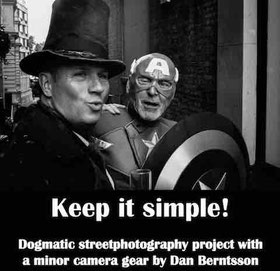
Keep It Simple free street photography eBookGet your FREE copy here:
https://www.streethunters.net/wp-content/uploads/2016/01/Keep-It-Simple-by-Dan-Berntsson.pdf