Tuesday, February 26, 2019

How to Photograph Your Family Vacation

In this article, I’ll show you how to photograph your family vacation starting with simple gear, creative photography tips, and the most important part – managing personalities and emotions.
“I tend to think of the act of photographing, generally speaking, as an adventure. My favorite thing is to go where I’ve never been.” – Diane Arbus
A grumpy moment on a family vacation. - How to Photograph Your Family Vacation
#Vacation#Family#Photography

Not every photo has to have a great big smile in it. My little girl was pretty grumpy at this moment. 
But I found something humorous about her expression as well as something artistic about the colors
and the distance between her and her shoes.
I was 9 years old on a family vacation when I first fell in love with photography. My parents let me snap some photos with their camera. From that moment on, all I could think about was photography!
In spite of how much I loved photography, I grew up taking terrible photos of our family trips, mainly because I didn’t know how to take good photos. But thanks to places like Digital Photography School, I’ve finally learned to take good photos of family adventures with my kids.

#1 – Itinerary and Gear

“By failing to prepare, you are preparing to fail.” – Benjamin Franklin
Your family vacation has a destination; you’re not wandering aimlessly. Your trip has a goal; perhaps adventure or relaxation. So too, should you also have a goal for your photos.
Why is a goal so important? Many families come home from a trip discouraged that they don’t have better photos of their journey. It’s easy to be distracted, lazy, or burnt out and just forget to take photos. But having a goal will keep you on track.
First step of the road trip is to wash the windshield! - How to Photograph Your Family Vacation
When my family took our first long road trip together I was determined to document the entire journey. This would also be my first big photography project.
Anticipation is one of the best parts of a trip. During the weeks of pre-trip excitement, consider what excites you most about your destination. Jot down some notes about things you’d like to photograph. Keep those notes in your camera bag and check them off as you travel.
Write the list when you feel most inspired and then it will guide you in the midst of vacation chaos when you are feeling rushed and less inspired.

Pack Lightly

Try to bring along as little photography gear as possible. Your kids will be asking you to hold their coats and hats, you’ll be carrying souvenirs, the last thing you want on top of that is a mountain of gear in an extra large camera bag.
Just a camera and rubber boots. - How to Photograph Your Family Vacation
This was my main gear for a trip to the Canadian East Coast; a camera and rubber boots! I also had a 
tripod but almost never used it. It was a pain to carry around and set up. I’d rather be free to move and
have fun with the kids than being loaded down with camera gear I won’t even use.
Here is a list of my favorite gear for traveling light on day trips and longer vacations.
  • Wide-angle lens
  • Telephoto lens
  • Underwater camera housing
  • Spare batteries
  • No tripod
The wide angle lens is perfect for landscapes, the telephoto lens for those far-off sights, and the underwater camera housing is perfect for beaches and oceans.
Remember, traveling light allows you to be free in the moment, instead of wrestling with gear. Some photographers constrain themselves to only one camera body with 1-2 lenses. This forces them to think more creatively about the scenes and moments in front of them rather than fussing over gear decisions.
Kids on a rock in the ocean. - How to Photograph Your Family Vacation
This photo was taken with my underwater camera housing. The ocean was so cold I was numb from
 the waist down!

#2 – Creative Ideas

“For me, the camera is a sketchbook, an instrument of intuition and spontaneity.” – Henri Cartier-Bresson
There is a lot that can be photographed on your family vacation. Always keep your camera handy rather than having it packed away in a hard to reach spot. There will be so many little moments to capture and you’ll get pretty discouraged if you miss them because your camera is packed away.
These 5 creative tips will guide you as you photograph your family vacation.

1. Photograph from inside the vehicle or plane

Mugs of hot chocolate on the dashboard. - How to Photograph Your Family Vacation
My wife and I journeyed to the south-west for one last trip before becoming parents. The desert was
hot but the mountains were cold! We brought a tiny stove with us to make hot chocolate along the way.
Depending on the nature of your trip, you may spend a lot of time inside a vehicle. Don’t waste the chance for some unique photos.
A view from inside the vehicle adds a different perspective to your photos. If every photo is shot from the same perspective or angle they will be boring. You want your friends and family to be excited as they flip through your photo book.
Mountain road view from inside the car. - How to Photograph Your Family Vacation
Driving mountain roads is my favorite part of every trip. I’m always torn between being the driver or being the passenger and taking photos.
View of a storm on the plains from inside the car. How to Photograph Your Family Vacation
Storms can be a beautiful part of the journey. Especially when you’re nice and snug inside the car!
A view of houses from a plane. How to Photograph Your Family Vacation
We had a friend who was training to be a pilot and took us to breakfast on a plane!
One dark cloud hangs over the road ahead. How to Photograph Your Family Vacation
Driving toward the Midwest United States, one black cloud hung over an otherwise cheerful sky. 
Maybe it was warning us that the next time we took a trip like this there would be two screaming 
toddlers in the back seat!

2. Locations and Landscapes

You’ll likely visit many beautiful landscapes during the day. But how would that same landscape look during beautiful evening light? Revisit some locations to take photos at different times of the day.
Monument Valley in Harsh Light - How to Photograph Your Family Vacation
This is Monument Valley during the harsh light of midday.
This is Monument Valley during the beautiful evening light.
Hall’s Harbour in the evening light. - How to Photograph Your Family Vacation
This is Hall’s Harbour in the evening light.
Hall’s Harbour in the harsh light of the day. - How to Photograph Your Family Vacation
This is Hall’s Harbour in the harsh light of the day.
Many of us take pictures of family members simply standing beside landmarks or landscapes. But there has got to be a more creative way of documenting the places and things you see.
Try photographing candid or natural moments while working landmarks and landscapes into the background.
Family photo at Peggy's Cove - How to Photograph Your Family Vacation
Here we are as a family. Do you know where this is? It could be any body of water in the world. I’m
glad we have this photo, but I had to get more creative with my backgrounds.
Colorful East Coast homes. How to Photograph Your Family Vacation
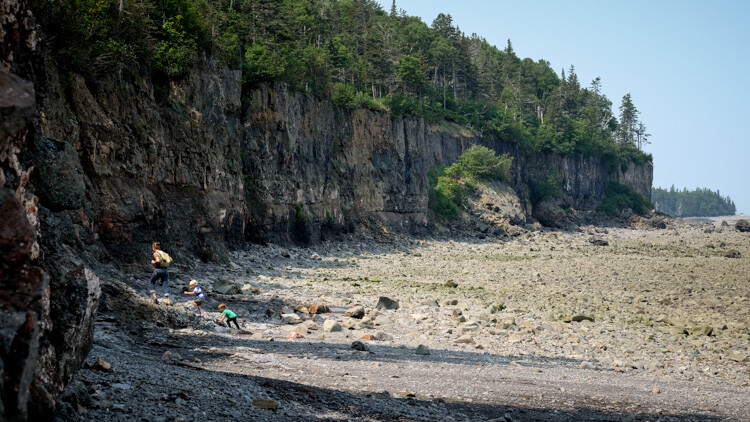
I loved the charm of these colorful East Coast homes, but I didn’t want photos of random houses. So
I made these homes part of the background instead of being the focal point of the photo. The bigger 
story is about my kids having a blast throwing rocks into the bay and the homes are part of the beautiful
scenery.
Photographing Niagara Falls - How to Photograph Your Family Vacation
I have many photos of my kids looking at the camera on vacation. But I wanted something more
creative. How about a silhouette with interesting framing?
Here is a simple question that will help you take better photos of the places you visit. Ask yourself, what is the essence of that place? Why do you love it so much?
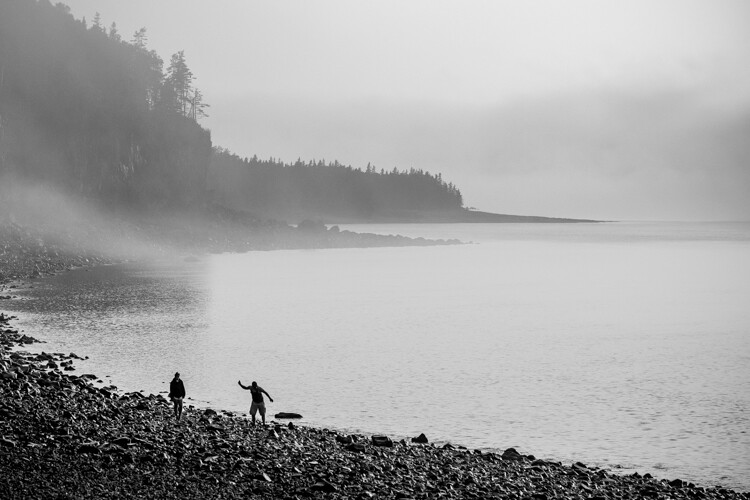
Skipping stones at Hall's Harbour - How to Photograph Your Family Vacation
I had many beautiful (and not so beautiful) photos of Hall’s Harbour. I wasn’t satisfied with any of
them and I wasn’t sure why. One evening I saw this couple come walking along and start skipping 
stones. That was it! That was the essence of this place; peace, solitude, skipping stones. This is a far 
more personal photograph to me.
Lighthouse at Summerside PEI - How to Photograph Your Family Vacation
In Summerside, Prince Edward Island, the vastness of the ocean overwhelmed me. That was the
essence of the place to me. No matter where you go on PEI, you are surrounded by the ocean. I 
composed this photo to portray that vastness. A tiny lone lighthouse in the distance.
When you’re among the massive rock formations in Utah, you feel very small and vulnerable.
Black and white photo of Niagara Falls - How to Photograph Your Family Vacation
Niagara Falls is one of the most nostalgic places on earth for me. It’s where I first came to love 
photography as a child. The viewfinder is an icon for travelers, and Niagara Falls is one of the most 
recognizable sights in the world. The slight misfocus, the grain, the black and white, all work toward 
capturing the essence of Niagara Falls for me; memories.
This is Monument Valley during the beautiful evening light.
Visit locations at different times of the day, think creatively rather than making your family stand beside things, and consider the essence of the place you’re in.

3. Moments

You’ll be busy photographing the obvious landscapes and big moments of your trip. But you will experience many little unexpected moments in those places. Photograph these odd moments too. You’ll find them to be very meaningful moments and love talking about them when you look back at your photos over the years.
Kids riding an escalator - How to Photograph Your Family Vacation
My kids loved their first trip to Niagara Falls and I loved sharing that place with them. It was also their
first time using an escalator (a moving set of stairs). They rode it over and over. I love this low angle 
perspective and how the main lines converge in the center of the photo.
A toddler making a mess of sunscreen. How to Photograph Your Family Vacation
My two-year-old daughter was being so quiet in the backseat. But you know when a toddler is being
quiet they might be up to no good! She had discovered the tube of sunscreen and applied it liberally!
Needless to say, she did not get a sunburn that day. If this had happened earlier in the trip I would have
freaked out. But by this point, I had learned to relax no matter what happened.

4. Food

Often you will experience new foods on your journey. Whether you like the food or not, photograph some of it. Viewing the photos of food will instantly trigger memories of the meals you shared.
A lobster on a plate. How to Photograph Your Family Vacation
We tried lobster for the first time! The sun was shining directly on it, giving such deep color to the
photo.
An empty plate of fish and chips.
Fish and chips is a must on the East Coast. The dinner was so good I forgot to take a picture until it 
was too late!

5. Hotels, campsites

Hotels and campsites are a blast for kids to explore! Make sure to capture some photos during downtime at the places you sleep.
A boy jumping across motel beds. How to Photograph Your Family Vacation
After a 10 hour day on the road, my son discovered just how fun beds in a hotel room can be. He was 
just barely able to leap the chasm between the two beds. He may forget the boring scenery, but he’ll 
love this memory.
A little girl with her face pressed up to the window screen. How to Photograph Your Family Vacation
Bathed and changed into fresh jammies, my daughter sits at the window with her nose pressed against
the screen.
Kids playing with their parents shoes. How to Photograph Your Family Vacation
Kids being crazy with our shoes while we pack for the next part of our journey.
At this point, if you’ve packed light (including your photo inspiration list) and taken note of some creative ideas, you’ll be set to take some great photos along the way.
But one thing threatens to ruin your photos and your trip – emotions.

#3 – Managing Personalities and Emotions

“Tears and sweat often bring out the best in us.” – Mister Rogers
Every family is different, but most families deal with a certain amount of drama on their trips. Learning how to deal with drama and negative emotions is critical for having a better time with your family and taking better photos.
Consider the fact that you won’t be in the mood to take photos if you are grumpy and your family won’t want to be in photos or do anything fun if they are grumpy. My family learned this lesson the hard way.
Little girl happy in the car. How to Photograph Your Family Vacation
Everything started out fine on our trip to the East Coast. Filled with the anticipation of the journey, 
we had books and snacks and things to do in the car.
Crying girl in car. How to Photograph Your Family Vacation
But my goal of a family adventure and a beautiful photography project is quickly met with a reality 
check. Our kids are 2 and 4 years old and we’re crammed into a little car – more often than not, it feels
like a disaster.
Two toddlers sleeping in the car. How to Photograph Your Family Vacation
My wife and I thought that we could easily relive the adventurous trips we took before we had kids.
But the reality was now very different. We had to plan for shorter days of driving, more motel stops, 
earlier bedtimes and lots of relaxed downtime.
A little girl with sand in her eyes. How to Photograph Your Family Vacation
But no matter what we tried, the first half of our trip was just a disaster. Not even a relaxed day at the
beach was any fun. The ocean winds blasted us with sand. We couldn’t enjoy ourselves for a moment. 
Even I couldn’t keep pretending to have fun. At one point our little girl ran into mama’s arms with eyes
full of sand from the relentless ocean winds.
A mom and boy playing in the mud. How to Photograph Your Family Vacation
The ocean tide was always leaving behind a shoreline of muck. Normally kids love mucking about in
the mud. But not on our miserable road trip. You know you’re in trouble when nothing makes your 
kids happy anymore. By this point in the trip, I was sure I’d have nothing but tear-filled photos for my
project.
A sleeping girl. How to Photograph Your Family Vacation
A week into the trip we were at our wit’s end. Finally, one Sunday, we collapsed in anger and
exhaustion and slept the day away. We woke up to the realization that this trip was a disastrous idea. 
At this point, I didn’t even care if I got photos or not. I just wanted my family to survive without hating
each other.
A family at a harbor. How to Photograph Your Family Vacation
Something happened when we let go of chasing new locations and perfect photos. We admitted defeat 
and just stayed in one place for a while. We actually fell in love with a nearby harbor tucked away 
from other tourists. Halls Harbor was our refuge from the crowds – and ourselves.
Slide at the playground. How to Photograph Your Family Vacation
For the first time, I finally understood what it was really going to take to make our first family vacation
a good one. We put the tourist life on hold and did the things that our kids really wanted to do – go to
playgrounds and throw rocks in the water!
A boy playing in dirt. How to Photograph Your Family Vacation
Frankly, when we gave up, that’s when everything changed. We even met up with friends who had also
journeyed out east. We could talk and unload our weakness as parents, confess the disaster we had 
made of this trip, and hear words of encouragement from our friends.
Family vacations are rarely the times of rest and relaxation that we hope them to be. Between kids fighting in the backseat and parents getting more stressed every day – sometimes I wonder why we ever go on trips!
But we can turn these challenges into a chance to grow as people. I learned a lot about our kids and myself on our first family road trip together. There were sweaty, tear-filled moments but we learned to embrace them and grow as a family.

Editing Life

Long after your trip has ended, you can relive the moments – and the lessons learned along the way.
Don’t forget about your photos. Print them, hang them, let them bring you joy until your next family adventure.
I sat at the kitchen table late one night reliving our trip through all the photos I had taken. The tears in the car. The tears on the beach. The tears in the mud. I thought about how naive we had been about traveling with toddlers. How we tried everything and failed. But also how the trip had been redeemed.
A photobook and a camera - How to Photograph Your Family Vacation
Just a couple weeks after that I was unwrapping a brand new photo book I made of our trip – my first
finished photography project.

Share this article.

Monday, February 25, 2019

Get Low and Aim High – How to Use Low-Angle Photography to Great Effect


One way you can make photos stand out is to compose them from an unusually low viewpoint. But why is low-angle photography so effective?
Good photography is hard to define, not least because there is always an element of subjectivity in judging it. Even when you have firm ideas about what great photos look like, there is no guarantee you’ll create them frequently. In fact, the more honed your tastes become, the less easily your own photos are likely to satisfy you.
Low angle photography - gate shot from below
#Angle Photography#Statues#Depthoffield

Shooting this Prague gate from below gave it more visual impact and a cleaner composition.
Is there any secret to taking eye-catching pictures? If so, I wish I could harness it. There’s one idea I try to bear in mind: show people things in your pictures they don’t see in their day-to-day lives. That means looking closely and seeing details, noticing the unusual, emphasizing the point of interest, keeping things simple, and knowing what to exclude. What is it you have seen and want to convey?
Low angle photography - statue looking downwards
Statues shot from below often work well when the subject looks down at the camera.
Used creatively, low-angle photography meets the criteria of being unusual and will often make viewers look twice. However, it needs a bit more thought than just pointing the camera upwards.

Getting low, aiming high

Of course, low-angle photography isn’t a radical idea in the context of photographing architecture or statues, because they will often rise above you anyway. Unless you photograph these subjects from distance, you’ll always be pointing the lens upwards. But even with these subjects, you need to get the angle of the shot right and consider what qualities you’re aiming to accentuate.
Low angle photography - St Dunstan's Hill in London
In this slightly eerie photo, the street name at the right adds extra interest and gives the picture scale.
If you’re photographing less lofty subjects such as people, animals or plants, you’ll have to get very low to make the perspective unusual. This, of course, could draw attention to you as a photographer, so you might have to shake off any inhibitions. Concentrate on the shot and you’ll soon forget about what other people think.

Architecture & statues

In the case of architecture, more ornate buildings (e.g. Gothic) aren’t always best shot from directly beneath, because all their detail becomes obscured or lost. You could photograph them that way and pick out a detail such as a gargoyle using shallow depth of field. The same can be done with statues on occasion, whereby you focus on an interesting part of the statue from below and isolate it.
Low angle photography - Canary Wharf in London
Three buildings add to the enclosed feeling of this photo, while the carefully positioned clock lends it
some scale.
Modern buildings like office skyscrapers often have the benefit of windows and lines, which narrow and converge if you photograph them from immediately below. This is an effective way of directing the eye towards the top of the building. Use of diagonals is an old trick for leading the eye into the picture, but you might need something else to make the shot a great one: perhaps a dramatic sky or cloud above the building.
Low angle photography - statue of Emmeline Pankhurst in London
Using a shallow depth of field, I isolated the eyeglass in the hand of famous suffragette Emmeline
Pankhurst, London.

Camera angle

There is no obligation when standing under a building or any other subject to keep it central or horizontal in the frame. By rotating the camera, often you’ll find an angle that increases the slightly giddy impression of towering height. This effect should not be underestimated. It’s a useful trick in low-angle shooting to make the viewer feel slightly disorientated.
Low angle photography - architecture
Left: Silhouette of Rouen Cathedral. Right: One Canada Square – the tallest building in the UK when
I shot it. The presence of a second building adds to the giddying effect.
When pointing a camera upwards inside a church or cathedral, I avoid including small sections of detail at the edge of the frame. Instead, I rotate the camera until everything in the picture looks intentional and not something I didn’t notice.
Low angle photography - Rouen Cathedral
This is an obvious shot to take of the Crossing Tower in Rouen Cathedral. The main trick lies in
composition and finding an effective angle.

People

Photographing people from a low angle produces some interesting effects. If you look at old “film noir” movie stills, you’ll see a lot of shots where the camera is pointing upwards. This gives portraits a moody feel and empowers the subject because he/she towers above the photographer and, ultimately, the viewer. The downside of shooting from below is that it can be unflattering, often making subjects look broader in the body and fatter in the face.
Low angle photography - casual portrait from a low perspective
A somewhat moody low-angle portrait. You’ll see a lot of low angles as well as low-key lighting in
old film noir movies.
You can shoot from low angles in street photography, too, whether from the hip or the ground. Be careful when shooting from the ground that you’re not invading anyone’s privacy by pointing the camera upwards—stay aware of your surroundings and watch who is entering the frame and how they are dressed.
Low angle photography - Venice Carnival
This shot at the Venice Carnival was taken from ground level. Without any prompting, the lady in the
 middle obligingly leaned over towards the camera.
The mere act of taking street photos from a low level may not, in itself, create a successful photo (if only it were that easy). You still need to have seen something interesting or out of the ordinary and the composition must be right. You might notice a detail at ground level and juxtapose it with the people above it.

Animals & pets

Many people photograph their pets from above, but if you get down to their level you can almost humanize them. That is to say, you’ll often capture their character better than from above. Like human subjects, photographing a pet from floor level gives it more power. An example of this might be if you photograph a cat preparing to pounce—you’ll put yourself in the position of the cat’s prey.
Low angle photography - Birman cat
Cats often take on that regal, aloof look when photographed from below.

Flowers

Sometimes you’ll get good results when shooting flowers from a low angle. One benefit in good weather is that you might get a plain blue sky as a background. Blue goes well with red and
yellow – the three together form a triadic color scheme. It also blends well with orange (e.g. California Poppies), since blue and orange are complementary colors.

This low-angle shot from many years ago was completely unsighted. I was aiming to contrast life
(flowers and bumblebee) with the WW1 gravestone and tragedy of war. I don’t know that I succeeded,
 but the idea still resonates.
Of course, it may not be color that inspires you to photograph flowers from below. You might want to emphasize a long stem or capture the translucent qualities of a flower’s petals against a bright sky. You might go for the dramatic effect of many flowers looming over the lens—a bit like a miniaturized forest.
Low angle photography - flowers
These flower shots from below aim to show the sunlit semi-opaque petals as well as color and shape.
The fact that they are tall flowers makes this treatment easy even with a bulky SLR.

Trees

Trees are a prime candidate for low-angle shooting, either individually or collectively. Like buildings, you need to stand immediately below them to make the shot even slightly unconventional and maximize the effect. Such photos aren’t always striking unless there is an interesting branch formation or pattern above, so you should take care in picking a subject. Colorful foliage is an obvious thing to look out for, too, especially during fall.
Low angle photography
I shot this mainly for its bark pattern and texture, using the blue sky as a pleasing backdrop. Interesting
branch formations or foliage colors might also prompt you to take such pictures.

Equipment

You don’t need any special equipment to shoot from low angles, but obviously a flip-out LCD screen is a useful thing to have. If you don’t have that, at least digital photography costs nothing to experiment with, so you can shoot blind until you get what you want. This was how I first took low-angle photos—with repeated unsighted exposures. A wide-angle lens might help you accentuate height sometimes with its sweeping view of the world, but this is not a necessity.
I hope this article inspires you to shoot some great low-angle photos, whatever the subject.

Share this article.

Full Moon and Eclipse Photography: Your Guide to Where They Are in 2019 and How to Capture Them Effectively


Jongsun Lee
#Eclipses#Fullmoons#Solareclipses 
Full moons and eclipses are a unique time to capture some interesting photographs.

Full Moons

Full moons usually happen once a month, with the occasional second full moon falling in the same month. This second full moon is called a Blue Moon.

Solar and Lunar Eclipses

A solar eclipse happens when the new moon passes between the earth and the sun, casting a shadow over the sun.
A lunar eclipse occurs when the earth passes between the full moon and the sun, causing the moon to fall into earth’s shadow. Lunar Eclipses occur only at the full moon.
To give you the opportunity to shoot the moon, below is a calendar of Full Moons and Eclipses for 2019, followed by some articles that will help you to capture the moon or eclipse effectively.

Full Moon and Eclipse Calendar

Full Moons

New York, N.Y (US/Eastern)
Date Time
Jan 21 00:17
Feb 19 10:53
Mar 20 21:43
Apr 19 07:12
May 18 17:11
Jun 17 04:31
July 16 17:39
Aug 15 08:31
Sep 14 00:35
Oct 13 17:10
Nov 12 08:37
Dec 12 00:14

Eclipses

Date Type
July 2 Total Solar Eclipse
July 16 Partial Lunar Eclipse
Nov 11 Mercury Transit
Dec 26 Annular Solar Eclipse

Full Moons

Sydney, Australia (AEST)
Date Time
Jan 21 00:17
Feb 20 02:53
Mar 21 12:42
Apr 19 21:12
May 19 07:11
Jun 17 07:38
July 17 17:38
Aug 15 22:29
Sep 14 14:32
Oct 14 08:07
Nov 13 00:34
Dec 12 16:12

Eclipses

Date Type
July 17 Partial Lunar Eclipse

Full Moons

London, England, UK
Date Time
Jan 21 05:16
Feb 19 15:53
Mar 21 01:42
Apr 19 12:12
May 18 22:11
Jun 17 09:30
July 16 22:38
Aug 15 13:29
Sep 14 05:32
Oct 13 22:07
Nov 12 13:34
Dec 12 05:12

Eclipses

Date Type
July 16-17 Partial Lunar Eclipse
Nov 11 Mercury Transit

How to Achieve Better Full Moon and Eclipse Photography


20 Dos and Don’ts for Shooting the Moon


The moon is a very popular subject for photographers of all skill levels to shoot. But if you’ve ever tried to photograph the moon, you’ve probably discovered that it’s not that easy to accomplish. In this article let’s look at some dos and don’ts to take your moon shots from snapshot to artwork.
Here the April moon called the "Pink Moon" rose over Marietta, Ohio. The setting sun lit the city in a warm glow.
The April moon called the “Pink Moon” rose over Marietta, Ohio. The setting sun lit the city in a warm glow.
To begin, the first and most important DON’T is: Don’t assume that photographing the moon is going to be easy.

#1 Do use a tripod

One of the most important pieces of equipment for any low light photography is a good tripod. Since the moon is so far away, it is very important to have a sturdy base as even the smallest movement of the camera will cause your image to blur. You might be tempted to think that if you use a fast enough shutter speed you can hand-hold the camera, but you need to realize that your subject is 238,900 miles away and even the slightest movement will be exaggerated.

#2 Don’t use a slow shutter speed

The moon is actually moving very quickly around the earth at a speed of 2,288 miles per hour (3,683 kilometers per hour). The moon is so distant, it doesn’t appear to be traveling very quickly to the naked eye. Because of the moon’s speed and the long focal length necessary to capture an image of the moon, you need to use the fastest shutter speed possible. A good rule of thumb for tack sharp moon photos is nothing slower than 1/125th of a second.

#3 Do use a telephoto lens

To successfully shoot any kind of detail of the moon in your image, you need at least a 300mm telephoto. For a full frame image, you will need around an 800mm lens.
Capture the moon

#4 Don’t use any filters on your lens

Remove ALL filters from your lens! To prevent any chance of distortion, don’t use any filters. Yes, even remove the UV filter. This may sound scary if you never remove the UV filter from your lens, but it’s best to remove to do so in this case. Some may suggest using a neutral density (ND) filter for moon photography to cut back the bright light of the moon. But, all this will do is require you to use a slower shutter speed, and you want to use the fastest shutter speed possible to get that crisp, tack sharp, image.

#5 Do try the Looney 11 rule

The Looney 11 rule is similar to the Sunny 16 rule. Set your f-stop to f/11, then match the shutter speed to your ISO. For example, if your ISO is set at 100, set your shutter speed to 1/125 of a second. (This is not an exact science but will give you a good starting point.)

#6 Don’t touch the camera to start your exposure

Do not manually press the shutter release or even touch your tripod when initiating your moon shot. Remember that even the slightest touch could add enough vibration motion to blur the image. Using a cable release or remote trigger is the best way to start your exposure. If you don’t have either of these gadgets, use the self-timer feature on your camera to begin your shot.

#7 Do use Mirror Lock-up

If your camera gives you the option to lock up your mirror this can greatly increase your chances of getting a tack sharp image. Even the slightest shake of your camera’s mirror can be enough to blur your image. If your camera has this option, use it! Lock the mirror up and wait a few seconds to allow any vibration to settle before beginning your exposure.

#8 Don’t use Image Stabilization

Canon’s IS (Image Stabilization) or Nikon’s VR (Vibration Reduction) must be turned off anytime your camera is on a tripod. Turning on any vibration reduction feature with your camera mounted on a tripod will actually create blur in your image.

#9 Do know the cycles of the moon

Use Photographers Ephemeris to predict the location of the moonrise
Use The Photographer’s Ephemeris app to predict the location of the moonrise.
There are 29.5 days between full moons. There are many online and smart phone applications that can help you track the phases of the moon. One must- have app is The Photographer’s Ephemeris which will not only give you the phases of the moon, but also show you when and where the moon will appear in the sky. This is especially useful when planning your moon shoots in advance. By far the most photographed stage is the full moon, which is also the brightest and the most difficult to expose correctly. The side lighting of the Gibbous stage produces some interesting shadows which may allow you to capture craters and mountains. The crescent moon is, of course, the darkest stage, but one which may create some interesting effects when added to a nighttime landscape.

#10 Don’t always place the moon in the center

While you can use all the usual rules of composition for your lunar photography, don’t be afraid to break the rules if the shot calls for it. Don’t just put the moon in the center of your image with nothing else –  it’s been done a million times before and there is nothing exciting about this. Try to include other objects in the frame with the moon.
Don't just place the moon in an empty sky, including a foreground object will create a more dramatic image.
Don’t just place the moon in an empty sky. Including a foreground object will create a more dramatic image.

#11 Do switch to manual focus

There are a couple of different methods you can use to focus on the moon: First, try using your camera’s autofocus, and once you have a desirable focus, turn off the autofocus and switch to manual focus. Alternatively, you can set your camera on manual focus, and with your live view feature turned on, zoom in on the moon and turn the focus ring until the moon becomes sharp. Then do not touch the ring again.

#12 Don’t just shoot the moon at night

The best time for photographing the moon is just after it rises or just before it sets, when it is very low in the sky. When the moon is near the horizon, it will appear larger in your images (a trick of the eye). Also, as the full moon rises the sun will be setting, and as the full moon sets the sun will be rising. This may give you great lighting to include or accentuate foreground or landscape objects. Shooting the moon in the day time will give you opportunity to include foreground objects, and you also may be able to capture some craters on the moon’s surface.
The June full moon called the "Honey Moon" captured here setting at sunrise
The June full moon, called the “Honey Moon”, captured as it sets at sunrise.

#13 Do use exposure bracketing

Once you have found the exposure that you feel happy with, it is best to bracket around that setting. The view of your images in the dark, on the back of your camera, can often be deceiving. In the dark, images always appear brighter on the LCD of camera than they actually are when opened on your computer. After you are satisfied with the exposure you have dialed in, bracket two stops under and two stops over, just to ensure that you get an exposure you will be happy with later.

#14 Don’t use Auto White Balance

Using auto white balance will give you very inconsistent results. What is the source for the light of the moon? That’s right, the sun! So try daylight white balance, but if you are looking for a different effect, try tungsten or cloudy. Don’t be afraid to experiment, but also remember that if you are shooting in RAW you can change the white balance in post-production.

#15 Don’t depend on your meter

Most likely your camera’s light meter will be fooled by the amount of light reflecting off the moon. Also it is important to note that as the moon rises, the exposure will continual change. It gets brighter as it rises, so you need to keep adjusting your shutter speed.

#16 Do shoot in RAW mode

Shooting in RAW will allow you to capture more details of the moon’s surface, and also give you more latitude for adjustments in retouching. So, unless you are not at all comfortable with using camera RAW software, always shoot the moon in RAW.

#17 Don’t be afraid to crop your image

Unless you are shooting with a very large telephoto lens, you will want to crop your image to display the moon at a decent size. But remember, the more you crop, the smaller the final image can be printed at high resolution.

#18 Do tweak and sharpen

Most moon photography is going to require some post exposure retouching in Photoshop or other photo editing software. Adding clarity and contrast will help bring out details which will enhance the craters and mountains of the moon. As mentioned above, white balance and exposure may also be tweaked to finish your optimal image, as both are somewhat difficult to perfect in camera.
Be creative: two images are combined together here to create this final image
Be creative: two images are combined to create this final image.

#19 Don’t be afraid to be creative

Don’t be afraid to get creative with your images of the moon. Most great moon images have been manipulated in post-production because of the difficulty of capturing a great moon shot in one image. HDR or exposure blending are great methods to enhance the captures of otherwise impossible moon images. A popular method used by many photographers is to combine two exposures: one set to bring out the best of the foreground landscape and a second exposed for the moon only. When combining these two images, try enlarging the moon slightly to achieve a more dramatic effect, but don’t overdo it to the point that it looks fake. It needs to look believable unless you are going for a science fiction affect (which isn’t a bad idea, creatively speaking!).
Two exposures were combined to make this final image. One image was exposed for the landscape and the other for the moon. The moon was enlarged slightly for dramatic effect.

 #20 Do Practice, Practice, Practice


How to Photograph a Solar Eclipse

Note: This article was written for a previous eclipse but is still relevant for the next one too!


On the afternoon of August 21, 2017, an event will take place in the United States that has not happened in almost 100 years. A total solar eclipse will be visible for a huge swath of the mainland population. While total solar eclipses aren’t an entirely uncommon phenomenon, it is highly irregular for one to be seen by such a large portion of the country and it won’t happen again anytime soon.
How to Photograph a Solar Eclipse
Image via Wikimedia Commons
In 2019 a total eclipse will be viewable for people in Chile, Argentina, and Uraguay and after that, the next one will not happen until June of 2020 which will be visible for a large chunk of Africa and southern Asia. This means that anyone who wants to get some good photographs of the upcoming event will need to spend time preparing, getting some essential gear, or even traveling to the USA if you live in another country.
Fortunately, you don’t need to spend thousands of dollars to get a good shot of the eclipse. This guide is designed to give you a good idea of what you will need without breaking the bank.

What is a solar eclipse?

To understand a bit about photographing a solar eclipse, it’s important to know just what it is you will be looking at on the afternoon of August 21st.
The moon orbits the earth once every 28 days, but the plane of the moon’s orbit is not quite even with the plane of earth’s orbit around the sun. Because of this disparity, the moon does not usually block out our view of the sun, except for once every few years. If the earth gets between the sun and the moon it’s called a lunar eclipse, but if the moon scoots between the earth and the sun it results in a solar eclipse which is rarer and, in my opinion, more spectacular to watch.
The fun part happens when you are lucky enough to be in the path of totality, which is where you will experience a complete blackout of the sun during the middle of the day. Keep reading to find out what gear you will need to photograph the eclipse, and how to locate the path of totality so you know where to be on this eventful day.
How to Photograph a Solar Eclipse - diagram
A solar eclipse happens when the moon passes directly between the sun and the earth. This diagram is
 most definitely NOT to scale.

How can I see the eclipse?

The most important thing to remember when viewing the eclipse of 2017, or any solar eclipse, is that you do not want to look directly at it unless you are in the path of totality – that is, unless the moon is completely covering the sun.
I need to make this abundantly clear: do not look at the solar eclipse with your naked eyes!!
Even if most of the sun is covered up by the moon, the light streaming out will be much too bright for your eyes to handle. NASA’s website has more detailed information, but suffice it to say if you want to watch the eclipse unfold in real time you will need something to protect your eyes like these solar eclipse glasses or a strong piece of welding glass. Sunglasses are far too weak to be effective and don’t ever just try to squint.
Protect your eyes properly, they’re the only ones you’ve got.
How to Photograph a Solar Eclipse - photo

How do I take pictures of the eclipse?

Here’s where things get a little tricky since you will probably need to spend a bit of money, though hopefully not as much as you think. If you want to get the kind of close-up images you’ve already seen in this article, you will need the following camera gear:
  • A zoom lens, preferably one that has a focal length of at least 400mm.
  • A solar filter to protect your lens and camera.
  • Solar glasses so you can watch the eclipse unfold as it happens.
  • A tripod to hold your camera steady.
  • A place to view the eclipse, free of obstructions.
Here’s a bit more information about each of those so you can make sure to get the best photos possible.

Lenses and Cameras

Most consumer-level zooms such as the Nikon 55-200mm lens or Canon 18-200mm do a good job at covering a variety of focal lengths. But shooting at 200mm isn’t going to handle an event like the solar eclipse with as much resolution and detail as you may want.
That’s where a longer lens such as the Tamron 150-600mm (or the Sigma version) really comes in handy. It will allow you to get a much closer view and to take the kind of pictures you might see on blogs and magazine covers. The downside is that these longer lenses are quite expensive.
Fortunately, there are several places online where you can use to rent lenses from for a few days at a time, which I highly recommend. BorrowLenses, LensRentals, and LensProToGo are popular sites that all carry a similar lineup of lenses, but it’s also a good idea to check with your local brick-and-mortar camera shop too. Many of these stores will let you rent lenses for a very short period of time, which is good since you only need one day to photograph the eclipse.

Tamron’s 150-600mm lens is ideal for shooting a solar eclipse, and you can find it online at places 

Alternatives

Another alternative is to look into buying or renting a teleconverter that will increase the focal length of your existing lenses. A 2x teleconverter can be rented for about $35 depending on your location. While the resulting images won’t be quite as sharp as if you were using a dedicated zoom lens it should be more than adequate to give you enough reach to photograph the eclipse with a lens you already own. (Note: Some point-and-shoot cameras have impressive zoom lenses but I would advise against using these for the eclipse because there’s not a good way to attach a solar filter to them, which I describe in the next section.)
Finally, it’s worth noting that crop-sensor cameras such as the Canon Rebel T6 Series or Nikon D3400, D5500, and D7200 are ideally suited for this type of event because they will give you more reach out of your lenses. A 200mm lens on a Nikon crop-sensor camera effectively becomes a 300mm lens, and the same holds true for Canon. Micro-four-thirds models have a 2x crop factor so shooting with a 200mm lens on the Olympus OM-D EM-10 is like using a 400mm lens on a standard full-frame DSLR. So for shooting the eclipse, if you have both crop-sensor and full-frame cameras you will be better off using the former instead of the latter.

You don’t need an expensive camera to get good shots. Even an older crop-sensor model like the 
Nikon D3200 will work great, provided you have a telephoto lens or a teleconverter.

Solar Filter

You wouldn’t look directly at the sun during an eclipse without proper protective equipment for your eyes, and the same holds true for your camera. If you are lucky enough to be in the path of totality you can look at, and take pictures of, the eclipse without needing any special gear. But if you are anywhere except the line of the complete blackout, or want to take pictures of the eclipse as it begins and ends, you will need certain equipment to keep your camera safe.
A special solar filter that attaches to the end of your lens is a great way to protect against damage to your camera. Not to be confused with standard neutral density filters, which are not at all strong enough for this type of situation, solar filters are specifically designed to photograph eclipses and other solar events. Make sure to find one that screws on, or fits over, the end of your lens and not one that goes between your camera and the lens. If it’s the screw-on kind it needs to actually fit your lens too, so double check that the thread size of the filter you get matches the thread size of your lens (look inside the lens cap for your lens, that is the filter size).

You will need a solar filter like this one from Amazon if you plan on pointing your camera at the
 eclipse at any point other than when the sun is completely covered by the moon.

Solar Glasses

These function much in the same way that a solar filter does, but are designed to protect your eyes instead of your camera. They are not expensive and look like the old style of 3D glasses you might have used in a movie theater decades ago, except these block out virtually all light except what comes from extraordinarily bright objects like the sun.
While wearing solar glasses won’t help you take better photos of the eclipse, it’s good to wear them as the Eclipse waxes and wanes so you can see it with your own eyes instead of through your camera’s viewfinder.

Solar glasses like these are required if you want to look directly at the eclipse as it begins and ends.

Tripod

Unless you have very steady hands or an impressive image stabilization system on your camera, a tripod is essential for shooting an eclipse. While you don’t need anything fancy or expensive, it will help to have a larger one that can keep your camera and lens rock steady. This is why I would recommend against small mount-anywhere tripods that you can find rather cheaply online.
If you are using a zoom lens with a built-in tripod mount, make sure to attach your tripod to that instead of your camera. Otherwise, you will put a great deal of stress on the mount where the lens attaches to the camera. Finally, any time you use a tripod make sure you disable your lens’s vibration reduction system because it can backfire on you and actually make your images more blurry when mounted to a steady surface.

A place to view the Eclipse

If you have all your gear ready, solar glasses on your face and your friends and family gathered to witness this historic event, it could all be for naught if you don’t put yourself in the proper location. The best spot to view Summer 2017’s Eclipse is by finding a location along the path of totality–the geographic line where you will see an entire blackout of the sun for as much as two full minutes. Places not on the path of totality will still see part of the eclipse, but the effect will not be nearly as pronounced.
Many towns and cities located on or near the path of totality have been taking hotel reservations for August 21st and are planning community events to promote the Eclipse. So if you haven’t started looking for lodging yet I would recommend making those plans now. This site has an interactive Google Map with all the information you need to get a good viewing location. Try to find a park, field, or another open area free of obstructions so that you can have a clear view of the eclipse. Though of course, weather plays a big role in this too and it’s entirely possible that your best-laid plans will result in rain or even just a lot of clouds.

Shooting Techniques

Finally, it’s important to keep a few essentials in mind so you can actually get the kind of pictures you are hoping for when the eclipse happens. Here are some tips that can make the difference between a blurry almost-had-it shot and a brilliant glowing halo that you would be proud to print and hang on the wall.
  • Use a fast shutter speed. It’s not about stopping the vibration of your camera, which is what a tripod is for, but freezing the motion of the moon as it travels across the sun. 1/125th of a second will be more than adequate, and going faster than that won’t really give you much of an advantage. Once again, make sure you have a solar filter or else you will damage your camera, and get a pair of solar glasses for your eyes too.
  • Use a small aperture, but not too small. Each lens is different, but in general f/8 or f/11 is going to give you a sharp image without much diffraction or chromatic aberration. Go much larger than that (i.e. f/4, f/2.8) and you risk getting an image that isn’t as sharp as it could be. Much smaller than that (i.e. f/16, f/22) will likely result in weird optical artifacts that happen as the light enters such a small opening and is reflected throughout the glass elements of your lens.
  • Shoot in RAW, not JPEG, and correct your white balance afterward in Lightroom, Photoshop, or another similar program
  • Use a two-second delay timer (if you’re shooting with a tripod) so you don’t get any vibration from your finger pressing the shutter, which can cause the image to appear blurry.
  • Use Live View to check for focus. Alternatively, you can use autofocus but make sure to check your pictures on the LCD screen right away to make sure they are properly in focus. However…
  • …Don’t spend all your time chimping, or looking at the LCD screen on the back of your camera after you take photos. You will only have a few minutes at most to take pictures of the total eclipse, and you will have plenty of time to admire them after it’s all done.
If you want to know more, PBS has a fantastic short video about the upcoming eclipse and you can find all sorts of information by searching online including NASA’s page dedicated to the event.
Do you have any other tips for getting photos of the upcoming eclipse? Please leave your thoughts in the comments below, and be sure to revisit this article after the eclipse to share your photos!
For those of you on Pinterest – here’s a pinnable image to share this post with others.


Tips for Photographing a Lunar Eclipse

_MG_5566-MWhile some obscure astronomical events get over-hyped, a total lunar eclipse is always a crowd-pleaser. It is easy to observe and photograph, even among the bright lights of the big cities.
Note: This article was written for a previous eclipse but is still relevant for the next one too!
A lunar eclipse occurs when the alignment of the moon’s orbit is just right, taking it inside Earth’s shadow at the time of full moon, when the moon is opposite the sun. The lengths of an eclipse can vary from event to event (as can the brightness and colour of the eclipse) depending if it’s a full eclipse or not
lunar_201504
Visit in-the-sky.org for eclipse event times in your part of the world. Change your location on the right hand side if the automatic selection is incorrect.

Photographing a Lunar Eclipse

There are two main approaches to photographing a lunar eclipse using just a DSLR and a tripod, excluding more complex approaches with telescopes and tracking mounts.
  1. You can get in as close as possible with a telephoto lens to capture detail of the changing partial, and total phases of the eclipse.
  2. Create wide-field and composite images showing the stages of the eclipse as the moon moves through the sky.

Wide-field Eclipse Composites

Lunar Eclipse over Maryborough Station-M
Partial phases of a lunar eclipse over Maryborough Station.
Canon 5D Mark II, 24-105mm lens at 82mm.
Nine exposures of the moon each 1/90 sec, f/8, ISO 200.
Images stacked is PS using lighten blending mode with one 2 second exposure of the foreground.
The moon moves across the sky at approximately 15 degrees per hour or 50 degrees over the full duration of the eclipse. You need a wide angle lens around 18mm focal length (28mm on a full frame camera) to capture all the stages of the eclipse in one field of view. An alternative is to frame up part of the eclipse with a longer focal length about 50mm (80mm on a full frame camera) like the image above which shows the partial stages in more detail.
In the northern hemisphere, the moon (like the sun) moves from left-to-right through the sky. So at the start of the eclipse, position the moon in the left side of the frame leaving it room to move across the image during the eclipse. Reverse that advice in the southern hemisphere. Night sky planetarium Apps such as Stellarium and SkySafari (iOS only) allow you to visualize the path of the moon through the sky to help plan your framing.

Telephoto Eclipse Images

With a moderate telephoto lens you can get nice detail of the changing stages of a lunar eclipse. During the partial stages the brightness of the moon allows for very short exposures, so trailing it should not be a problem, although you will need a sturdy tripod and use mirror lock-up to reduce vibration.
Lunar Eclipse Partial Phases Composite Canon 1100D, 300mm lens with 1.4x teleconverter, 1/125 sec, f5.6, ISO200
Lunar eclipse partial phases composite.
Canon 1100D, 300mm lens with 1.4x teleconverter, 1/125 sec, f/5.6, ISO 200
During totality, the Moon’s brightness greatly reduces, however this eclipse will be a little brighter than usual. Aim for exposures of around one second with the aperture wide open, and push the ISO as much as you need to, being careful not to blow the highlights on the brighter edge. You should be able to capture images like this one below, which is an example of what you can do even with regular affordable cameras (although nice lenses do help).
_MG_5566-M
Totality during a lunar eclipse
Canon 1100D, 300mm lens with 1.4x teleconverter, 1/2 sec, f/5.6, ISO 200

Eclipse at Moonset

In the eastern United States and Canada, and the western half of South America, the moon will set during the partial stages before total eclipse. Through central areas the moon will set while totally eclipsed which will make it much dimmer than a normal moonset and potentially hard to see amongst bright city lights. In the western half of North America you get to enjoy the partial phases leading up to, and including the total eclipse, then capture the moon setting as the partial phases reverse at the end of the eclipse.
You can use apps and software like The Photographers Ephemeris (Android/iOS) and Photo Pills (iOS only) to plan the alignment of the moon against landscape features as it rises or sets. Australian photographer Colin Legg captured this shot of the moon rising during an eclipse last year. An astronomer would immediately recognize the unusual configuration – a crescent moon can normally only appear in a twilight sky in the same direction as sunrise or sunset. Here the crescent moon appears amidst the beautiful shading of Earth’s shadow and The Belt of Venus, opposite where the sun set about 15 minutes earlier. Similar images before sunrise will be possible across North and South America during April’s lunar eclipse.
2014-10-08-Lake-Ballard-Lunar-Eclipse-115mm-1200
Lunar Eclipse over Lake Ballard, Western Australia – image courtesy of Colin Legg
Will you get out and give it a go?

 Share this article.

Sunday, February 24, 2019

How to Choose the Perfect Portrait Lens

Portrait taken with 85mm lens
#Portraitphotography#Lenses#Zoom

A question I often get asked at Photography School is which lenses are best for portraits. It’s a tricky question because the answer is subjective. It depends on your budget, personal style of photography and the make of camera. It is further complicated by the relationship between sensor size and focal length.
Let’s start by exploring some of the things you need to think about when choosing the perfect portrait lens.

1. What about the lenses you already own?

It may be that you already own a lens that you haven’t thought of using to take portraits, but could actually do the job quite well. Do you have a 50mm prime? Or maybe a 100mm macro lens? A 70-300mm zoom? All of these are capable of being great portrait lenses.
Even if your only lens is a kit lens, you may still be surprised by how well it performs (within its limitations). You can read more about that in my article Why Your Kit Lens is Better Than You Think.
Getting to Know Your Lenses will also help.

2. Do you need a zoom lens or a prime?

Prime lenses are great for portrait photography. One advantage is that they have a wider maximum aperture than a zoom lens covering the same focal length. This is useful for creating images with shallow depth-of-field (a common technique in portraits). It is also handy in low light, as it lets you take photos with faster shutter speeds or lower ISO than you could with a zoom with a smaller maximum aperture.
Canon EF-S 18-55mm lens
Another benefit is image quality. Prime lenses tend to have less elements than zooms, and the result is that image quality is better, and they produce sharper images with more contrast and less lens flare. If you’re on a budget (see next point) then an inexpensive prime will give you better results than an inexpensive zoom.

3. What’s your budget?

This is an important consideration because, as with most things, good quality lenses cost more. The best example of this is Canon’s 50mm lens range. There are four models, ranging from around $110 to $1600 in price. That’s a big difference, and your budget determines which model makes it to your shopping list.
More expensive lenses usually produce sharper images with less flare. The construction quality is better, they may be weatherproofed and have better or quieter autofocus mechanisms. The difference in image quality is usually greater between expensive and cheap zoom lenses than it is between expensive and inexpensive prime lenses.
The other trade-off (besides cost) for better quality built lenses, is extra weight. Top of the line lenses are usually made of metal and are heavier than the less expensive plastic lenses.
Bear in mind that good camera lenses should last decades, and sometimes spending more up front is beneficial in the long run. In the words of Sir Henry Royce (of Rolls-Royce):
The quality is remembered long after the price is forgotten”.

4. What focal lengths do you require?

The answer to this question depends on the size of your camera’s sensor (our article Crop Factor Explained tells you why). Rather than discuss specific focal lengths it’s easier to split lenses up into four categories. Once you’ve figured out what category of lens you’re interested in, and whether you would prefer a prime lens or a zoom, you can investigate which models are available for your camera.

Wide-angle lenses

Wide-angle lenses are good for environmental portraits – those where you keep your distance a little from the subject and include their surroundings. They are generally not as good for close-up portraits as they distort your subject. Here are some examples:
Portrait taken with 25mm lens Portrait taken with 17mm lens

Normal lenses

A normal lens is one with a focal length equivalent to around 50mm on a full-frame camera (that’s around 35mm on an APS-C camera, or 25mm on a Micro four-thirds camera). You may have read that these lenses give a similar perspective to that of the human eye. It’s a debatable point, but there’s no doubt they are interesting for portraits, occupying the middle ground between wide-angle and short telephoto lenses. They can be used for close-up portraits, although not completely without distortion (see image left, below)
Portrait taken with 50mm lens
A “normal” 50mm lens portrait
Portrait taken with 85mm lens
A short telephoto 85mm lens

Short telephoto lenses

These lenses are often called portrait lenses because they are an ideal focal length for taking flattering photos of people. You can move in close and take images without distortion, or step back and include the entire figure without moving so far away that it becomes difficult to communicate with your model. If your short telephoto is a prime lens, you get the additional benefit of wide apertures. Best of all these lenses, especially primes, tend to be reasonably priced.
My favourite lens for portraits is an 85mm prime lens (you can read more about it in my article How a Humble 85mm Lens Became My Favourite). (see image right, above)
If you have an APS-C camera then a 50mm prime lens is effectively a short telephoto. Yes, I’ve written about 50mm lenses too – let me point you towards Nifty Fifties – Why I Love 50mm Prime Lenses and Why a 50mm Lens is your new best friend.

Telephoto lenses

Telephoto lenses are often used by professional fashion and portrait photographers for the compressed perspective and their ability to isolate the model from the background. The downside of telephoto lenses is that they tend to be more expensive than shorter focal lengths, especially if you’d like one with a wide maximum aperture. They are definitely heavier as well. Having said that, there are plenty of relatively inexpensive lenses, especially zooms, in the 100mm-200mm range.
Portrait taken with 150mm lens

Selecting a focal length

If you’re unsure which focal lengths appeal to you, try this exercise. Go onto Flickr or 500px and do a search for portraits. Mark any you like as favourites. When you have marked at least twenty, go and have a look at them together. Examine them carefully and think about why you liked each one. Are there any common themes? Which focal lengths are used the most? Are the photographers using wide apertures for shallow depth-of-field? Are they predominantly black and white or colour? Is the photographer using natural light or flash? Are they predominantly close-ups or environmental portraits? The answers to these questions may help you decide which lenses to shortlist. Read more: 5 Easy Steps to Choose the Perfect Prime Lens for You
Canon EF 85mm f1.8 lens

My thoughts

I’m going to be specific and tell you exactly which lenses I use. My favourite lens for portraits is my Canon EF 85mm f/1.8 prime lens. I use it for approximately 80% of the portraits I take. I also use my Canon EF 40mm f2.8 pancake lens (it’s a moderate wide-angle) on my full-frame camera and, occasionally, a Canon EF 50mm f1.4 or EF 17-40mm f/4L zoom. The next lens on my list is a 24mm prime, and when I buy one I’ll no longer use the 17-40mm zoom for portraits. I favour primes over zooms because of image quality and the wider maximum apertures.

Share this article.