Sunday, August 17, 2014

Ferguson Missouri Images


FERGUSON  •  Long before the nation rested its collective conscience on the protests along West Florissant Avenue, there was a different mobilization going on.
Hundreds of people were moving out of their urban neighborhoods to this north St. Louis County suburb seeking a safe and affordable place to live.
They found it in an isolated corner of Ferguson that was flush with sprawling apartment complexes. Far from Ferguson’s leafy residential streets and quaint downtown, many people didn’t even know the apartments were part of the city until young Michael Brown was shot and killed there Aug. 9.
But not the police. They knew.
After decades of relative calm and stability, the apartments have become a tinderbox for crime. Canfield Green Apartments and the nearby Oakmont and Northwinds complexes are a study of the slow encroachment of poverty and social distress into what had been suburban escapes.
Angela Shaver has witnessed that sea change since she moved into Canfield Green Apartments 20 years ago. The state employee said she raised a prom queen there and sent her off to college.
There used to be a swimming pool. Now, there’s a bullet hole in the door below her.
That shooting, and many others, happened long before all the vigil candles melted in the middle of the street for Brown.
Even as Shaver explained the frequency of gunfire, she was cut off by a sudden blast coming from Northwinds Apartments, a hulking spread with more than 400 low-income units.
Boom!
Shaver paused to listen. No screams. No more shots. She picked up the interview where she’d left off.
“I hate to say I got used to them,” she said of the gunshots.
Ferguson’s crime and poverty rate is lower than some of the other North County municipalities. But the small southeast corner of the city where the apartments are glows bright red on crime maps.
That area along West Florissant Avenue and just east of it accounted for 18 percent of all serious crimes reported between 2010 and August 2012, according to a Post-Dispatch analysis of crime data provided by St. Louis County.
The area accounted for 28 percent of all burglaries, 28 percent of all aggravated assaults, 30 percent of all motor vehicle thefts and 40 percent of all robberies reported in the city of 21,000 people.
It’s a cluster of densely populated complexes that stand apart from the predominantly single-family streets of Ferguson.
On a map, the area sticks out like an appendage, one that was added to Ferguson by annexation. Many of the children who live there aren’t even part of the Ferguson-Florissant school system.
Adding to that isolation, police have blocked off nearly all access roads to the apartments with concrete barriers, fences and gates.

Pentax K-3 (not a film camera)

While I am (and always will be) an analog (film) Photographer, I realize that some who read this blog have made the switch to digital equipment.  As I've often stated before, I have nothing against digital photography, it's just not my preference.  But, for those of you who have decided to pursuit our art form digitally, this post is for you.  Enjoy.  

Pentax K-3 Officially Announced (See our detailed preview here!)

Well, it's finally here! Pentax has just officially announced the K-3, a 24-megapixel DSLR featuring all-new hardware and the best specs of any Pentax camera to date.

Pentax K-3: Announcement and Detailed Preview by PentaxForums.com

  • 24-megapixels
  • No AA filter, but the SR mechanism can be used to simulate it if desired
  • 8.3 FPS shooting up to 60 frames at full resolution
  • 27-point AF
  • 60 FPS 1080i video with full manual controls and H.264 format
  • Wireless tethering support
  • 200,000-frame shutter life
  • 0.95x viewfinder and 3.2" LCD
  • $1299
Please visit our homepage for a detailed preview of all the K-3's features, as well as some hands-on comments:


Pentax K-3: Announcement and Detailed Preview by PentaxForums.com


I have secured an exclusive deal for PF members who pre-order the K-3 at B&H: all kits will include a free 32Gb SD card as well as a spare battery.


Purchase links:

undefined

Special silver edition (2000 worldwide, couple hundred for the US market):
undefined
Pentax K-3: Announcement and Detailed Preview by PentaxForums.com


Read more at: http://www.pentaxforums.com/forums/16-pentax-news-rumors/239023-pentax-k-3-officially-announced-see-our-detailed-preview-here.html#ixzz3AeahL6jn

ROLLEING


_DSC2339
I received this camera a few years ago as a gift from my mother, it has been in our family since the 1960s, this camera has seen more action that all the cameras I have ever own. As soon as I got my hands on it my friend gave me a roll of 120 expired film and started my experience with this trusty friend. Let me tell you that after coming from digital where everything is fast and almost instantaneous I had to pace myself, slowdown and really think what I was doing, every exposure was important, I had to be really careful to remember to wind it for the next exposure, and check the exposition on the light meter before every shot.
Carlos020
Rolleiflex 2.8F. @ Carlos Ocando.
After overcoming all the differences I started to really enjoy working with this camera, there is a feeling when you see through the viewfinder, is like a warm feeling from the past, a nostalgia that never ends, it only grows in you and stays with you for a while, what’s interesting about this is that you can also feel that in the photos, I can’t quite put my finger on it, it’s just lovely.
Carlos022a Rolleiflex 2.8F. © Carlos Ocando.
Cameras are not important, but history is, and I think film photography is a part of human history, a part that I think it should not disappear, film cameras and prints created from film have different aesthetics than digital cameras and files, it could be good or bad for you, but I love it!. If you have the opportunity to work with one of these cameras or other cameras from the film age (Bronicas are really good cameras with very low price in the used market) don’t think it twice, get a box of 120 or whatever film the camera uses and go out!, as always feel, explore, and have fun. From Rolleiflex Land I salute you!
_DSC2343a
Nikon D600 + Nikkor 60mm f/2.8. © Carlos Ocando.
If you liked this post and want to help me keep writing about photography, share my blog, reblog it, or click the donate button, Thank you!.
by: Amigo Photo
Donate Button

Saturday, August 16, 2014

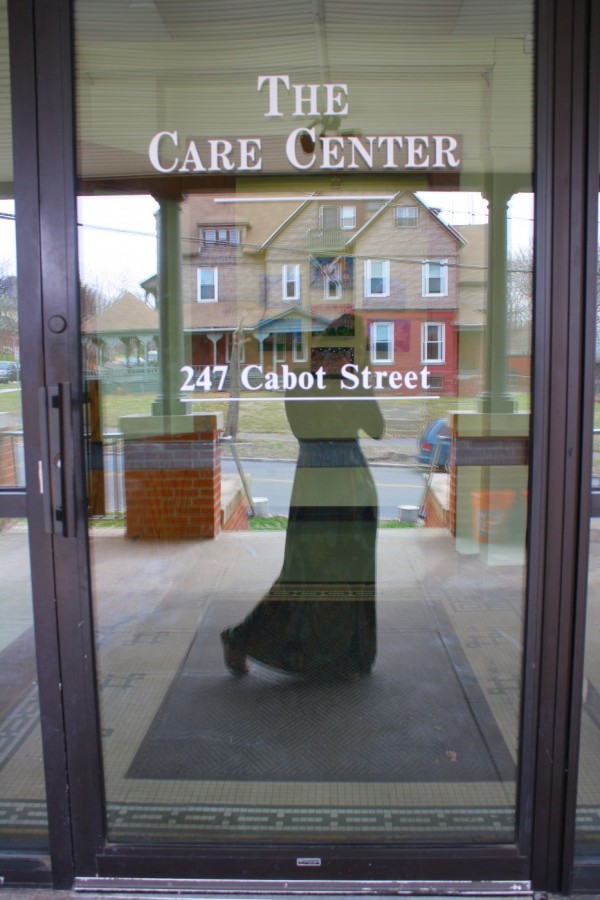
The Care Center

Photography

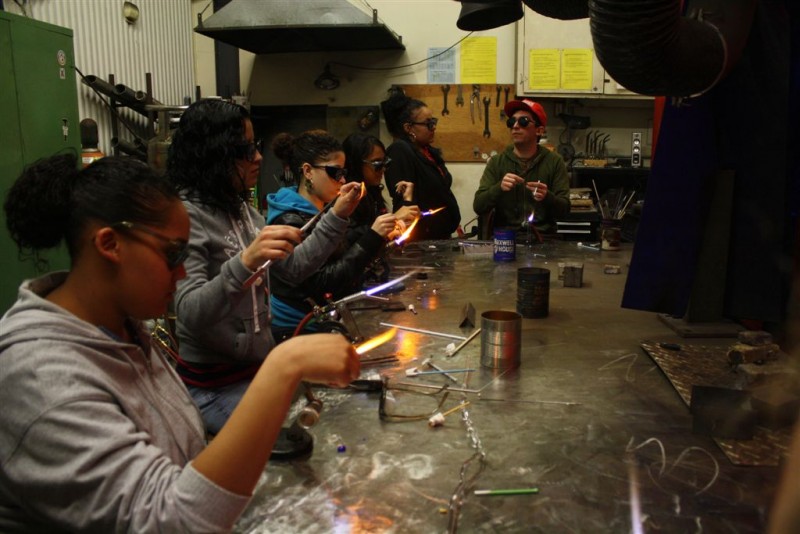
Since 2003, Care Center students have taken photography classes taught at Hampshire College. Hampshire College students teach Care Center students photography techniques in digital film, Photoshop, and new media. Hampshire College’s Center for Film, Photography and Video hosted a major exhibition of Care Center students’ work in 2009. In 2010, we had photography exhibits at the Wistariahurst Museum in Holyoke and the Hosmer Art Gallery at Forbes Library in Northampton.
By Clive G -
hewholuvsfotos@gmail.com -
57698708-09
Back in the day, it was every Photography student’s dream, including mine, to own a medium-format camera. Whereas the SLR cameras we owned produced negatives that were just 19mm wide by 35mm long (hence the term 35mm film), medium format cameras used 120 film and produced negatives that were 60mm wide and 60, 70, 80 or 90mm long, depending on the make of camera. Bigger negative meant that bigger and more detailed prints could be made and so, we naively believed, our photographs would be that much better.
The trouble was, medium-format cameras were considerably more expensive than 35mm cameras. Art students have never been renowned for their wealth, what with having to buy their own materials and running up large tabs at the local hostelry, so for many, including myself, owning a medium-format camera remained just a dream.
Rolleiflex-TLROne day some years after graduating and not long before I first came to Oman, I visited the Egyptian Rooms at the British Museum in London. It was a lovely balmy evening when I emerged from the Middle Kingdom and so I decided to walk down to the River Thames. My route took me along Museum Street and it was there that I passed the window of a second-hand camera shop. Among the many vintage cameras in the window was a 1959 Rolleiflex TLR for the very affordable sum of £95. I returned next day with my chequebook and bought it.
Whenever I show this beautifully engineered camera to young people these days, many of whom seem to think that film photography dates from Tutankhamen’s time, their first question is usually “Why does it have two lenses?” The answer is that the top lens is the one through which, by means of an internal mirror set at an angle of 45˚, the photographer views his subject and composes his photograph, while the bottom lens is the one through which the photograph is taken. This is why the camera is known as a twin lens reflex (TLR), the word reflex in this context meaning that the image is reflected to the photographer.
The second question these children of the digital age usually ask is “Why is the image in the viewfinder back to front?” To which I reply, “Have they stopped teaching basic physics in schools along with everything else?” To which they usually reply, “No, but physics is really boring and anyway we’ll never use it in our lives when we grow up.” Well, at least the arguments that are advanced by school kids for not studying haven’t changed over the years.
The Rolleiflex TLR is not without its drawbacks, the biggest being that it has no built-in light meter and so it needs to be used in conjunction with a hand-held meter in order to get correct exposures. But whatever its limitations, these are far outweighed by the Carl Zeiss f.2.8 lens which, coupled with the 60mm square negatives the camera produces, captures pin-sharp images that can be enlarged to almost one metre square without any loss of detail.
A couple of years after coming to Oman, I became friends with a photography nerd by the name of Derek. Independently of each other, we had been struck by the ethereal luminescence and colour of the sky over Muscat in the five minutes immediately after sunset during the winter months. So between us we came up with the hair-brained idea of producing a book of photographs taken during that five-minute window, which we would call Muscat — City of Light.
For the best part of half a year, Derek and I photographed Muscat from every conceivable angle during that five-minute window, I using my old Rolleiflex and Derek a Hasselblad. We climbed to the roofs of tall buildings, we scaled mountains, we were attacked by feral dogs and we got told off by the police and the army on numerous occasions. Derek and I spent hundreds of rials on film and hundreds more on getting it processed. Eventually, we had about 100 photographs that didn’t look too awful, so spent months putting together a mock-up of the book to show to a publisher in Dubai.
Now before you rush to your local bookshop or log on to Amazon.com to order your copy, I should tell you that the book never made it into print. Don’t get me wrong, the publisher in Dubai loved it, wanted to go to town on the design, do a print run of a couple of thousand copies, throw a lavish launch party in one of Muscat’s top hotels, invite a famous person to make a speech, the works… as soon as we gave him a cheque for several thousand rials as insurance against poor sales.
The photographs I took on my Rolleiflex for the ill-fated Muscat — City of Light have been languishing in my photographic archive for the past 22 years, unloved and unused. But just for your delectation, I have pulled three of them out, scanned them and include them here. I don’t know what you think (though I’d be delighted to hear your feedback) but my first reaction when I scanned them was ‘My word, aren’t they colourful!’
I am sorry to say that I rarely take my old Rolleiflex TLR with me when I go on photography trips these days. Why that is I cannot really say, for I still think it is a smashing camera and great fun to use. I did, however, take it for a spin to Al Hamra a few months ago, loaded with black and white film. Just to show you how much a photographer’s aesthetics can change over the years, I include one of the images here.
If you would like to have an enormous amount of photographic fun and take super high-quality photographs that you can blow up to huge sizes, then the good news is that old Rolleiflex TLR cameras are available on ebay. The bad news is that they have become much sought after in recent years. The cheapest one I could find with the Carl Zeiss f.2.8 lens was going for about £500, which is five hundred times more than you might pay for a Bakelite Kodak Brownie 127. So, does that mean the Rolleiflex is five hundred times better? Well, no, but if I had the choice between five hundred Kodak Brownies 127 and one Rolleiflex TLR, I know which I would choose.