Ferguson, Mo., unrest tests legal right to film police
Reports from Missouri suggest police are demanding that people stop using mobile phones and other cameras to film their activities. Whose side is the law on?
In Ferguson, Mo., where demonstrators have been protesting the shooting death of Michael Brown, people have been filming their encounters with police.Scott Olson/Getty Images
The protests and rioting that have followed Saturday's shooting death of unarmed black teenager Michael Brown by police in Ferguson, Mo., have raised multiple issues. One of them concerns the rights of citizens and journalists to film law enforcement.
Reports from Ferguson suggest that law enforcement officers -- many from the St. Louis County Police Department -- have become aggressive in their requests for members of the media and others to stop filming with their mobile phones and other cameras.
Over the last few years, as smartphones have become almost ubiquitous, police officers across the US have occasionally responded with anger to being filmed in the course of their duty. Some situations seem trivial, others much more serious.
The law, though, has only really been tested since 2011. And legal decisions move far more slowly than technological developments.
In essence, citizens do have the First Amendment right to film police officers in their line of duty in any public place. The one caveat is that those filming shouldn't be obstructing the officers in the process.
"As long as you stay behind the police's yellow lines, you have the right to film or photograph them," Clay Calvert, a University of Florida professor of mass communication, told me Thursday.
When it comes to the two reporters who were arrested, Calvert said he could see no evidence that the journalists were somehow impeding the police in their line of work.
First Amendment rights are, however, sometimes treated in a more fluid manner by police acting under extreme stress or merely attempting to unreasonably assert their authority. Some police officers, Calvert said, prefer that the First Amendment issue is decided in a court, rather than debating it on a street.
In the case, for example, of a traffic stop, when police have no idea with whom they might be dealing, gray areas arise -- at least in a police officer's point of view. The individual may be armed. There may be other safety concerns.
One case that remains up in the air is between Carla Gericke and the Weare, N.H., police. She tried to film a traffic stop involving a friend in 2010 and was charged with breaking wiretapping laws. The charges were dropped, but she has sued the town and the police department. Her suit reached the US Court of Appeals. which sent it to US District Court for a jury trial.
Now, as the New Hampshire Union-Leader reports, Gericke must try to persuade a jury that she complied with police instructions amid the filming. The police contend that her behavior disrupted them in the line of duty. Who will the jury believe?
It's no surprise that with inconsistent behavior among the police with respect to filming, sites like Photography Is Not A Crime exist to reveal instances that might not otherwise be seen or heard of.
Just last week, after the filming of a New York police officer allegedly choking a man to death, the New York Police Department had to remind its officers of the law. As the New York Daily News reported, the NYPD sent out a memo that read, in part: "Members of the public are legally allowed to record police interactions." The memo added: "Intentional interference such as blocking or obstructing cameras or ordering the person to cease constitutes censorship and also violates the First Amendment."
In essence, though, once the police had threatened the media's rights to film them -- as opposed to targeting, as some do, citizen journalists -- their public standing was even shakier.
Friday, August 15, 2014
SHOOTING FILM (AGAIN) // OLYMPUS TRIP 35 + KODAK BW400CN
by: Maira Martins
About two months ago I did something crazy: I placed a bid for a batch of 41 rolls of expired film on ebay. And I won! Back in 2005, when I started learning photography, I shot film. It’s not a glamorous story, really. There were not many digital cameras available and even if there were plenty, I simply couldn’t afford one. All I had was an old Minolta XG-1 from 1978, inherited from my father, and one single lens, a 49mm f/1,7. Heck, I was so broken I couldn’t even afford buying and developing film! But I loved that camera! I read and studied a lot and practised by doing air-photos (I was pressing the shutter, I just didn’t had any film inside the camera, lol!) so that on the few occasions I could use film, I wouldn’t blew completely my chances – and my finances.
Fast forward to 2011. I moved to SWEDEN to live with Jaanus and he bought a digital camera for us. He knew I loved photography and wanted to stimulate me to get back to learning it. That was my first DSLR. I had a simple point and shoot digital camera (and plenty of film ones, for with time I ended up building a little collection of cheap 35mm compact cameras) but that was a completely different game. A DSLR!!! I finally had the chance to take millions of photos of the same thing, and to understand how light works by actually seeing the results right there and then! I still think this is a fantastic learning tool, to be able to shoot as much as I want and then download everything and immediately SEE what I have done. However, it also made me a bit more lazy. Suddenly, knowing I could take 1000 photos of ___ (insert any subject you want here) caused me to stopping doing an effort to actually find the best combination of light, angle, lens for that same subject. Digital photography made me more comfortable in so many levels, but film photography used to make me take more risks. And risks are a big part of the learning process and developing one’s style.
So that’s why I bought 41 freaking rolls of expired film. I have no pretensions of being the next José Villa, I don’t even plan to buy medium format cameras and call myself a film photographer. No. But I felt I had to go out with the oldest and cheapest camera I could think of, with expired and unpredictable film and to risk coming home without a single picture to tell the story. That would be an exercise for me to get back to that mindset I had before, that every single frame was precious, was expensive and I only had a single chance to make it right.
So here it is, world. My (re)first roll of film. Have fun!
Shot with a 1967 Olympus Trip 35 (bought for 75 sek in a 2nd hand store, or about 10 usd) and a roll of Kodak BW400CN expired in 2007, developed by CARMENCITA FILM LAB. The whole film was exposed with +1 to compensate for the age. Not sure if that was the best move, as the film is quite contrasty under bright light and absolutely useless in low light. The camera works with focus zones, which is haaard. Still trying to get the hang of it. And loving the results, so far!
Former Derby photographer discusses tech changes in photo industry
The photo archives of the Kentucky Derby that Ray Schuhmann keeps show the evolution of photography: glass plates, film and digital.
For more than 50 years, Schuhmann, president and CEO of Kinetic Corp., was the Derby's official photographer and archivist. I spoke with him a few weeks ago in preparation for Business First's 30th anniversary publication, where he reflects on the changes the tech industry has seen in the last three decades.
Part of my conversation with Schuhmann included the photography business. I wanted to learn how he has seen the industry change since Kinetic Corp. began offering photo and lab services in 1968.The Louisville company has evolved and now offers translation-management services.
Schuhmann, who says he's a Nikon guy, used to work with art directors almost every day, he said. But today, people don't get that experience, and the photo and lab business has lost a bit of its creativeness.
"Craftsmanship and art is gone," he said.
It's gone, he said, because of digital technology. "People accept immediacy over quality. The industry has changed that good enough is good enough." Schuhmann admits that the quality of photos produced by digital cameras is amazing. But the switch from film to digital was a hard one. He witnessed color labs go out of business because they failed to evolve.
"You had to make the adaption (to digital), despite it not being cost-effective," he said. Though Schuhmann and Kinetic no longer photograph the Kentucky Derby, they still maintain the archives.
To photograph the Derby, each year he would gather a team of about 20 photographers. He noted that the switch from film to digital opened the photo floodgates. With film, he would have to sort through 3,000 to 4,000 photos. When they made the switch to digital, that number jumped to 14,000 to 15,000 images.
Plymouth photographer makes mark with low-tech approach
Written by
Matt Jachman
In an era of instant gratification and digital everything, Joan Meyers’ photography sets her apart.
Meyers, a portrait photographer who last month opened a studio in downtown Plymouth, favors black and white rather than color and, perhaps more unusual, works with film rather than in a newer digital format.
“It’s the perfect medium for me. It matches my personality,” Meyers, of Plymouth Township, said Monday in her second-floor studio on Forest, upstairs from the boutique Birchwood.
Black and white, she said, gives photographs a contemplative, timeless quality better suited to capturing emotion and personality, while film offers more variation in tones and a grainy look that appeals to her more than the just-too-perfect digital.
“Not everybody likes this type of photography,” said Meyers, who joked that she was born in the wrong decade. “Some people pick up on it right away.”
Meyers started out in photography as a hobbyist using film, then made the switch to digital, along with most other photographers, when that format became dominant. But she was drawn back to film and to shooting portraits in black and white. She’ll also shoot in color, she said, to give clients a choice, but it’s in black and white that she’s making her mark.
Working professionally for seven years, Meyers specializes in family portraits: mother and child, siblings, whole families. She also offers hand-coloring of black and white photos; the finely detailed portraits of classic houses (including one of a large brick house in Plymouth) that adorn her studio have an old-fashioned colorized look from the days before color prints became commonplace.
Meyers can develop her own film and make prints at home, but usually sends out portraiture work to a lab in California. Final prints are made on archival-quality fiber paper; printed photographs, she mused, are a medium that’s likely to outlast the computer discs and flash drives on which people now store their family photos.
Most of her portraits are done in subjects’ homes – it’s there that clients are most likely to be themselves, she said – but photo shoots can also be done in her studio, which has white walls, a dark wood floor and lots of natural light.
Meyers said film sometimes piques the curiosity of young people who grew up with digital photos and that there seems to be a resurgent interest in film. There are even Photoshop options, she said, designed to give digital photos a film-like look.
“It’ll never be what it was before,” Meyers said of film, “and that’s OK.”
Meyers’ husband Bob works for Chevron Oil, while son Nate, 20, is a college student and daughter Erin, 18, is college-bound. Their youngest, Peter, is 11.
Joan M. Photography can be reached at 734-386-0505; the website is http://joanmphotography.com/. Meyers is currently collecting new blankets (store-bought or hand-made) for Project Night Night, which distributes blankets and stuffed animal toys to children who have to leave their homes suddenly because of emergencies or dangerous conditions. See her website for details.
Thursday, August 14, 2014
Secrets to Crafting Top-Quality Beauty Portraits: Studio Lighting
In this article I would like to share some of the basics and tips for those of you who enjoy shooting beauty portraits with controlled artificial lighting.
Of course, the way we handle light on location or in studio and the physical laws of light are still the same. Human sense of sight has a very high dynamic range, whereas the dynamic range of digital camera sensors is many times less than that of the human eye (Wikipedia - Dynamic Range in Photography). Therefore, in order to create a more realistic photograph we should try and match the luminance range of a scene we're capturing to what we normally see with a naked eye. So, when it comes to lighting in photography, ultimately our goal is to increase Dynamic Range by filling in dark shadows and capturing details in both the brightest and darkest parts of the image. Unless of course, your creative idea behind the photo is to achieve dramatic, moody light.
That is where traditional studio lighting principles begin, and we sure often deviate from that with our creative ideas and artistic lighting. I like experimenting and breaking some rules too, but whenever I am browsing through my new images in Lightroom, one of the main elements I am watching closely for is clipping in the highlights and shadows.
I always try to avoid that and the sure way is, of course, lighting my portraits properly. If I didn't do a great job with preserving details in both shadows and highlights with my lighting, I still have a chance to save them by getting the best out of my Raw files. But since we're here today to talk about lighting, let me share with you my thought process and decisions in various shooting situations.
Light Modifiers
My most favorite and most often used light modifiers for key light are Beauty dish and large softbox. Which one I choose for a particular shoot will depend on a few circumstances:
How big the area I want to illuminate is: full body shots (softbox) or close-up beauty (Beauty dish), or both types of images in one photo shoot (softbox).
My subject's skin condition: flawless, even skin will allow me to use a slightly harder light (Beauty dish) and for aged or problematic, uneven skin I will use a softer light to avoid exaggerating skin problems and make my post-production stage easier and quicker (softbox).
My creative ideas: sometimes even if I'm shooting close-up beauty, or simple portraits, and my model's or client's skin is great I may still go for a softer light, if that's what I envisioned for the final images of that particular photo shoot.
Many faces in one photo shoot: when I am shooting for a client with a few models, which I did not select and haven't seen before the shoot. I will normally setup softer light (softbox), just in case some of my models have less then ideal skin.
If you ever wonder what light modifier was used in a picture you like, learn to "read" light by the form and size of catchlights in the model's eyes and hardness/softness of the shadows on her face in myHow to "Read" Light in Photography.
Beauty Dish
In this image I used a Beauty dish as my key light source modifier. My silver reflector was in front of the model to fill in deep shadows under her nose and chin, and regular metal reflectors on the background and rim light sources.
My model's skin was flawless and we had an amazing Makeup Artist on set, so I knew that harder light was perfectly acceptable in this situation.
Model: Shah of Aston Models, LA, Makeup & Hair: Germaine Nichols
If you have never shot with a Beauty dish, or just starting out, I strongly recommend that you watch this video by Sean Armenta, Los Angeles based beauty, fashion, lifestyle and celebrity photographer, which he recorded for the Fstoppers BTSV contest a few years ago.
Softbox
For the following two photos I used a large softbox as my key light and the rest of the setup was the same as in the previous image. It was a photo shoot for Pravana, a Los Angeles based hair product company, and I had ten models to photograph.
Besides, this photo shoot was all about hair and hair colors, so I chose to go with a softbox to capture the main details in the most flattering light, and avoid creating more retouching problems if one or more models did not have nice, even skin.
If you haven't been regularly shooting with the mentioned above light modifiers, you may not notice the difference between the lighting in these images (Beauty dish vs. Softbox). Yes, it is very subtle, but you will learn to see it as you shoot and analyze your images more.
It usually is quite easy for an experienced photographer to determine what light modifier was used as key light in a photo, which means the difference is there and it is visible to a trained eye.
Start training yourself by assessing the depth, darkness and hardness of the shadows under the models' noses and chins and you will soon be able to tell the softbox light/shadow from the Beauty dish light/shadow.
Beauty dish light is always just a tiny bit harder (= darker and more defined shadows) than softbox if you're using a diffuser (a "sock"), and even harder than that if you're using a grid.
Regular Metal Reflectors
For the background and rim light sources I always use simple metal reflectors. The light they shape is very direct and hard, but by adjusting strobe power and its distance from the backdrop or the model you can achieve nice rim and background light.
Silver Panel Reflector
And of course, there's always my irreplaceable lighting tool - the 40" silver reflector.
It is always silver, because I don't want any color cast in the reflected light, which you may get if you use a golden reflector. And white reflector does not reflect the light as well as silver.
If you don't have a reflector you can easily make one by taping or gluing aluminum foil (the type that we use in the kitchen, approx. $5 for 75 sq ft) to a piece of cardboard. Or just use a silver sun shade from your car - it's also relatively cheap ($10-20) and does a great job.
If I ever fail to bring my reflector to a shoot (it's super rare, but does happen), I will fire one of my additional strobes or flashes into a white wall behind me. Or even just into a large bright surface behind me, if the walls are painted into a color other than white, or are too far away to bounce the light off and fill in the shadows on my subject.
In the following two images that I photographed during my recent Beauty Photography workshop in Umbria, Italy (organized by Photoshop Guru Marianna Santoni), you can see how drastic the difference is between dynamic range in photos shot with and without a reflector.
These images are deliberately demonstrated unedited, so you can see everything as shot.
Model: Selene Gnavolini, Makeup: Francesco Riva of Chanel, Hair: Geordie Nonlaimpiccheranno
Color Gels
I use color gels to alter colors of the light sources in my images.
Make sure to check out my article Shooting With Color Gels, if you like artistic, colorful lighting.
Color gels that you can buy online and in camera stores are usually of various density, which will affect the amount of output power you need to set your lights to. I personally buy simple colored gift wrapping paper from hobby & crafts shops and because it's very thin, I sometimes have to fold and double it to achieve richer colors.
In the next photo my lighting setup included a Beauty dish on a boom as a key light, regular metal reflectors on the light with orange and blue color gels behind the model.
Reminder: when shooting with color gels, remember to turn off the modeling lamps to prevent the gels from melting.
Model: Tori Tracy, Makeup & Hair: Mikala Jean Vandenbroucke
Other Light Modifiers
And even though I have said earlier that I mainly shoot with my two most favorite light modifiers, I still sometimes use other types such as umbrellas, octaboxes and regular metal reflectors.
For example in the following lighting setup I used a 7-foot octabox, because we were shooting a collection of images with close-ups and full body length shots. This large light source allowed my models to have as much freedom for movement as they wanted.
Model: Tori Tracy, Makeup & Hair: Mikala Jean Vandenbroucke, Fashion Designer: Eliana Smith
In the next image I fired my strobe (key light) into an umbrella. I photographed it during my trip to Las Vegas in 2012. This light modifier choice was made simply because I could not fit my Beauty dish into my suitcase.
The quality of this light is slightly different from both softbox and Beauty dish - it is a little harder than Beauty dish in my case, but you can soften the light if you shoot through an umbrella.
An umbrella may not look as professional as the other two when you mount it on your light at a client shoot, but it is still a great light modifier for portraits and close-up beauty, which you can easily travel with.
And lastly, I sometimes use a regular metal reflector to shape my key light as well.
Just like I mentioned before it gives a hard, very direct light, which may visually resemble sun light in photos. You can see what it looks like in the following image where we used only one light source:
Model: Aja Warren, Makeup & Hair: Samantha Ward
Light Meter
One last thing I want to mention today is light meters.
I've owned one for years, because we had to purchase it when I was in my Photography college. And I I've only used it maybe a dozen times overall. I'm an artist and I rely on my senses, I prefer to see and "feel" light, and assess my lighting by test-shooting and adjusting it a few times in the beginning of a shoot. But I still always carry it in my backpack to every photo shoot, because it is very helpful when you have to set up your lights very quickly. Or when you are, for example, shooting with new or rental lights.
Of course, there are many more other lighting modifiers, setups and tools out there, these are just my preferences, solutions and tips. Now that you know what these light modifiers do, go ahead and try shooting with the ones that you liked. Remember about the "1 percent inspiration and 99 percent perspiration" rule and practice as much as you can!
And before you go here's a little lighting quiz for you:
What light modifier is my dear colleague Jerrit Pruyn using in his beauty shot? :)
Why I’ve Gone Back To Shooting Film...And Why You Should Too
Our DSLRs have confused us. We obssess over the wrong things. Sharpness at 400%; bokeh characteristics of lenses produced from what-must-surely-be prancing magical unicorns; high speed burst frame rates that make cameras sound like gatling guns; 4k resolution to shoot better cat videos; 100 auto focus points that still won’t focus on what we need them to; and noise performance at 400,000 ISO. Absolutely none of these will make your photographs better. Shooting film will though, here's why.
Last month, I bought my first film camera in a decade. A Leica M6. Yep say all you want to say about Leica users (it's probably all true), this camera has changed the way I shoot, and been the single best investment in any piece of gear in years.
I grew up shooting film as a kid and we actually had an attic darkroom, thanks to my dad’s hobbyist photographer leanings. Shooting on film again isn’t some indulgent trip down a nostalgic lane though. It has snapped me out of the digital malaise and reminded me what it means to actually make a photograph.
What on earth am I actually talking about here? Well, our DSLRs turned us into the equivalent of photographic sloths. We wander about with too much gear, sluggish pulling the camera up, staring at our LCDs and wondering where all the love and emotion went.
Ok I’m being somewhat ridiculous, but I’m sure some of you out there in the back row are nodding in solidarity and agreement.
It’s not just me that feels this way. Last month I shot some video for Emily Soto for her NYC fashion photography workshop. As you can see from the video I shot, what is amazing to see is how much film features throughout the learning experience. The polaroids, the Impossible Project film, and even the medium format and large format systems the attendees had brought along themslves – it all added to the overall aesthetic of the style of fashion photography that was being taught. Sure digital was being shot too - everyone had their DSLR, even a digital medium format camera was in attendance - but there was a definite sense of excitement when people shot polaroid and revealed what had been captured.
The ability to shoot thousands of RAW images to a single card, to take a dozen images in a single second and to basically shoot as much as we want with almost no direct costs involved is turning us into brain dead zombies. So what can we do about it?
Is Film The Answer?
Film is just the medium. I don’t care so much about the medium (although I do love the look of film) - it’s the process that interests me.
Film forces you to work different “photographic muscles” much harder than when shooting digital. Here’s the ten things I’m now doing differently through the process of shooting film:
1.) I’m making selects in-camera, not in Lightroom
Film forces you to think about each shot, because each shot costs money. Film and developer costs are about 30 cents each time I click the shutter. That finite value of a limited number of shots on a roll, and developer expense makes me assess if it’s worth it before the shot, not try to weight it up after the fact in Lightroom. Less time in front of the computer, more time shooting makes me happy.
My new workflow for Lightroom - more fun than my old workflow
2.) I feel "the moment" more, and get a true sense of achievement
"What on earth is he smoking?", you're probably wondering? Well hippy'isms aside, you have no idea what you’ve got. No way to check an LCD. Each shot must be made to count (even if it doesn’t, there is a sense it should). Your confidence about “the shot” increases as you get more shots that work. When you get the developed film back and see you nailed it, there is no better feeling. Digital doesn’t come close to this sense of achievement. This isn't about being elitist and shouting from your moutains "Look at me, I am the greatest photographer in the city because I understand how to shoot film!". It's about better understanding exposure, motion and light - and how that can help you in the digital world.
Contrary to popular belief amongst my photographer friends, I was not hiding in the bushes while shooting this image
3.) You become more aware (particularly of backgrounds, light and composition)
This is easily one of the best skills I’ve become attuned to, and it’s translating into my digital stills and video work. Shooting black and white only has got me thinking much more about background and composition, and how light is falling on my subject. It’s adding greater depth to the images I take.
Background separation and subject movement are all coming together to produce what is essential an image of what I'm seeing looking in one of New York's dirtiest puddles. Beautiful moments captured amongst the finest dirt that New York has to offer!
4.) I am being forced to better understand light
Although my camera has a built in light meter, I’ve become accustomed to different shutter and aperture settings in different lighting conditions. At first it’s a little tricky, even if you shoot manual in your DSLR. I also have a greater understanding of my reciprocals and have become much more adept at quickly adjusting shutter and aperture simultaneously, all of which translates into the digital world very readily. This is about being ready to capture moments while others are still fumbling with dials and settings.
After i took this shot, this guy reached level 2000 of Candy Crush and fist pumped the air for 20 minutes straight, but this was the last shot on my roll so I missed the action.
5.) I can anticipate the moment better
My lens is manual focus, the camera is a rangefinder. I shoot at a snails pace now. This is a goodthing. This is a great benefit of shooting with film, because it forces you to try and pre-visualize what you want to happen. If you are shooting sports, weddings, people or anything that is not still life, this is an essential skill to hone. The best photographs tend to be the in-between moments, those unexpected instances. Being quicker to anticipate these is a great skill
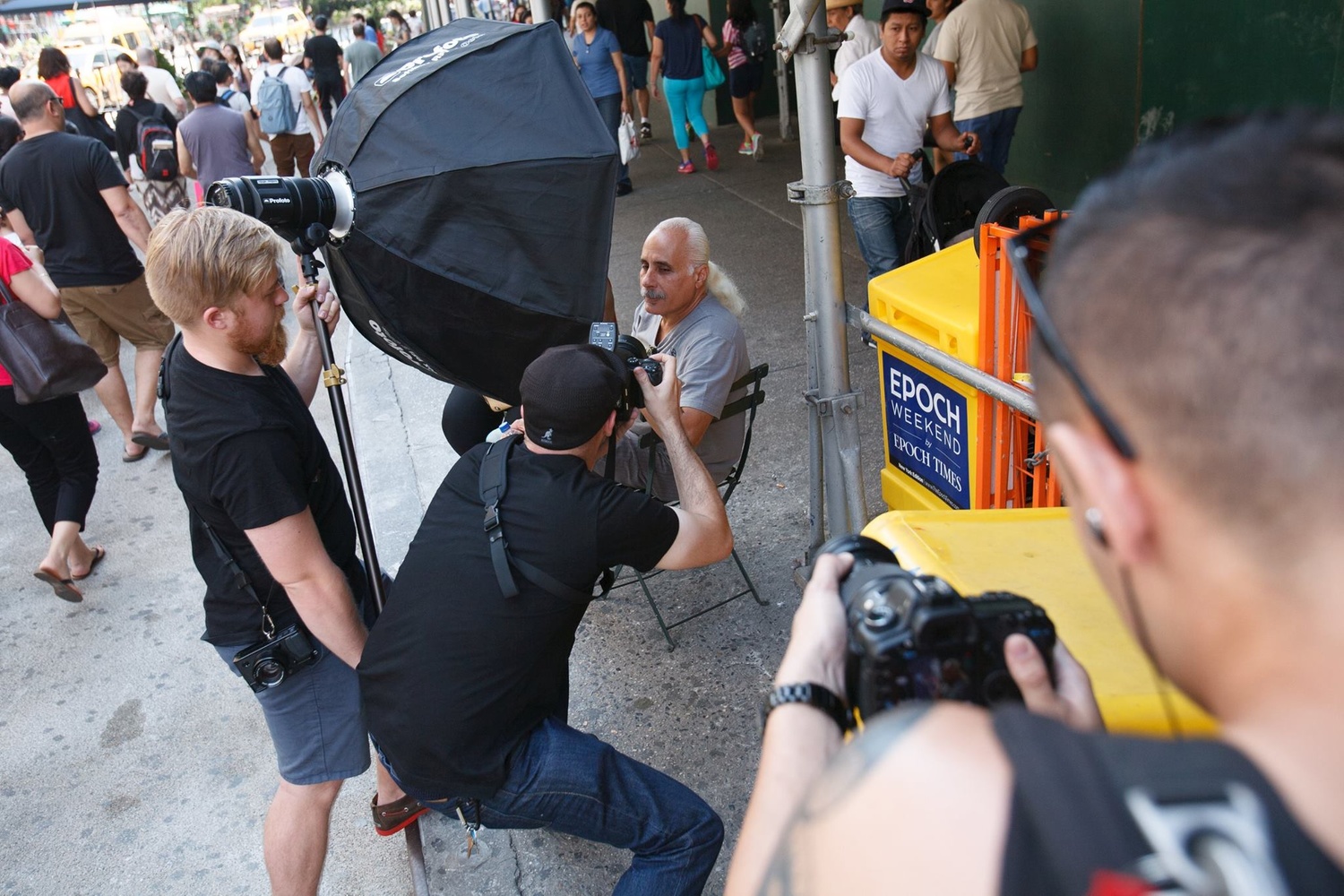
This image combines so many things I love - reflections, New York streets, a slight tilt used with restraint, and an old weathered man with awesome facial hair in some sick-looking mirrored shades looking somewhat perplexed. Ah, the things we love and are drawn to shoot!
6.) I’m much more patient
I live in New York - any time I get a chance to practice patience, I take it. The more time I spend doing any type of photography, the more I realize it’s about shooting less, slowing down and observing more. Sure, there might be times you want to shoot off a huge number of frames each second, but if you’re trying to convey an emotion or evoke a mood, I think it’s far more worthwhile to wait, watch, direct a little and have a clear vision in your head AHEAD of what you shoot, rather than shooting and looking at images, trying to work out what you were trying to say. Shooting film is a cure for the over-shoot-because-we-can digital sickness I often find infected with.
This was one of my first shots with film after a 10 year hiatus. It took me forever. Fortunately the subjects in this shot didn't move a muscle. They might have been dead and propped up, I have no way of knowing, I hope not. Either way, fortunately they were still enough for me to compose around them
7.) I’m no longer weighed down with gear
I cannot tell you how transcendentally magical it is to carry one lightweight film camera and one lens, a 35mm. I’m not only lighter, but I can see and frame an image with my eyes before I even pull the camera up. Shooting one camera and one lens allows you to pre-compose with practice, and is a great way to practice photography without shooting a single photograph. “Know thy tools so they get out of thy way” was some famous saying someone once probably said, and it’s definitely true.
Not being weighed down means you can respond when the action calls for it! Like this shot, when I saw a horse walking a woman along a New York City cross walk (a much more common occurrence in this city than you might otherwise think)
8.) Between sharpness and a better photograph, sharpness loses everytime.
I love sharp digital images, don’t get me wrong, but I firmly believe our ongoing obsession with it is causing us to overlook our connection to the image. I mean, who doesn't love poring over lens charts? Over sharpened, perfect images are like digital razors to my eyeballs. Imperfection is beautiful. Sharpness doesn’t make a good image, it can make a good image better (if used tactfully) but focusing on just getting something sharp can make an image lifeless and boring. I love the emotion of motion blur, and grain in film, it gives us something organic that connects us to the images we see. We're humans, not robots, and some of the images I see could easily have come from the brain of an awesomely-cool-looking-yet-emotionally-barren android photographer.
Is this image sharp? Sort of. Does it convey a man who looks trapped and caged like an animal? I think so. Do i prefer the way it makes me feel over how sharp it is or isn't? Definitely.
9.) Post processing an image takes 30 seconds, not 30 minutes
Because I love the natural look of film, I’m rarely spending more than 30 seconds on each image when I am messing with them in Lightroom. I’m not spending as much time in front of a computer, I’m just shooting more and that’s what makes me happiest.
If this was a digital file, I'd probably still be at my computer pulling 18 slides around, wondering what looks better. As it is, I now have more free time to wait on subway stations, trying to frame people in small squares while surrounded by other small squares. I know where I'd rather be! (I'm not sure why, but at least I know where I'd rather be)
10.) Film is timeless
Whichever way you cut it, you cannot beat the look of film or it’s archival properties. It’s why Scorsese, Abrams, Tarantino, Nolan and other Hollywood directors pulled together last month, to try and save Kodak film stock. Sure, it’s dying – Kodak film stock sales have fallen 96% over the last ten years, but the fact it’s still around, and still in demand by many top directors says a lot about the special place film has in many of our hearts
Film - making beautiful people look naturally beautiful since 1851 (or whenever film was invented). Thanks to this young lady and to Lindsay Adler for allowing me to shoot her model after their awesome editorial shoot together
Here is an image of the lovely patient Spencer, from Emily Soto's recent NYC workshop. She only had to hold this pose for a mere 18 minutes while I fumbled around while I manually focused a rangefinder and tried to work out how to expose correctly (I'm joking for comedic value here - it wasn't that long at all, probably about 16 minutes in reality)
Final Thoughts
So am I done with digital? Of course not. In the space of a few days last week, I shot a Polaroid land camera and a Phase medium format camera. Different tools, different jobs.
Here I am traveling back in time with Vic Soto's Polaroid film camera...
...and then later the same week, shooting into the future with the awesome that is a digital 50megapixel Phase. Remember - use what works best for the job at hand - or if you fancy a challenge, don't, but that might be harder
Will my film camera replace my digital camera? Not on your nelly. That’s not the point of the article. Digital is great, but with all the cheap advancement in technology and limitless opportunity it brings, it can turn us into stumbling, photographic zombies if we're not careful.
I am thoroughly enjoying the process of film again because I feel like I’ve been snapped out of the digital daze. It’s not so much a trip down memory lane but rather, a useful sharpener for my photographic skillset. You don’t need a Leica. A few hundred dollars gets you a cheap 35mm film camera, a lens, a basic-but-effective film scanner and some rolls of Tri-X to get you started. It’s hardly a serious financial risk and I’m wholly confident you’ll get a sense of at least some of my experiences. At the price of a cheap second hand piece of glass, what have you got to lose?
When was the last time you saw a digital camera look this cool? Exactly. Case closed. Go shoot some film. (side note: if anyone DOES have a digital camera mounted on a thing like this, please post in the comments)
Thanks: all images used are my own apart from the two of me - thanks to Vic Soto and Manny Tejeda respectively for each of those. Thanks to Lindsay Adler and Emily Soto for their kind permission to shoot some film test shots during their shoots last month.


 Model: Shah of Aston Models, LA, Makeup & Hair: Germaine Nichols
 Model: Carey, Makeup & Hair: Pravana Artists & Stylists
 Model: Carey, Makeup & Hair: Pravana Artists & Stylists
 Model: Selene Gnavolini, Makeup: Francesco Riva of Chanel, Hair: Geordie Nonlaimpiccheranno
 Model: Tori Tracy, Makeup & Hair: Mikala Jean Vandenbroucke
 Model: Tori Tracy, Makeup & Hair: Mikala Jean Vandenbroucke, Fashion Designer: Eliana Smith
 Model: Jamillette Gaxiola, Makeup & Hair: Sherri Jessee, Assistant: Mikala Jean Vandenrboucke
 Model: Aja Warren, Makeup & Hair: Samantha Ward